 |
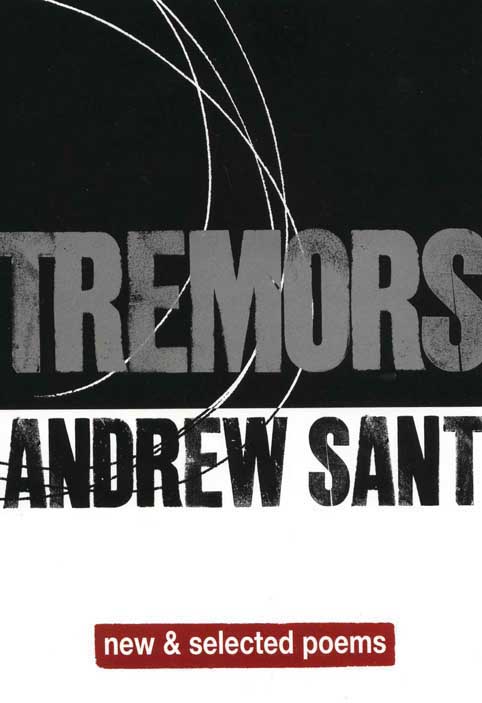
Tremors (new and selected poems) : Andrew Sant |
||||||||
 |
Book Description You get the sense of the poet poised with antennae aquiver for vibrations of an invisible world... not only as a receiver of the vibrations of the world but also as an amplifier and broadcaster. Martin Duwell, Australian Book Review Andrew Sant writes intellectually compelling and formally taut poems... made possible when an exceptional facility with language collides with everyday subjects. Brian Henry, Poetry Nation Review The poems are witty, acerbic, intelligent... Russian Ink is a rich collection complete with – there seems no other word for it – muscular verse which dances through the pages. Nicolette Stasko, Southerly Andrew Sant is a craftsman who is not afraid to take risks with language and themes. This book is a major work by an important, innovative poet. Anthony Lawrence The Mercury ISBN 1876044500 2004 258 pgs $27.95 |
||||||||
Book Sample
Reviews Tremors, New and Selected Poems Geoff Page The Book Show - Radio National Out
of the house, I take books for protection.
Pricey. On buses, trains - in cafes - they save me from dangers. Every page. I glance up, lower my reading glasses, see how many others are dependent on hefty novels or self-helps with bold covers. A lot look pale. For this they pay, scan the reviews, and cough up again. What I shell out is my own business but, sure as hell, it’s not The Book of Kells saves me, in heavy traffic or stymied by a cancelled train, from old age. A real page turner has got the force to hold at bay the pricks who profit, at increasing speed, from urban damage – and it’s a thriller if their regulators know how but not when they’re going to cop it. I pay. I pay. There’s sod all chance this bout of spending will ever stop. Now the room I call my study is full of muscle, wall to wall. Shuttered. And where I tough it out. The situation you’ve just had defined in Andrew Sant’s poem, ‘The Protection Racket,’ will be familiar to most listeners of The Book Show. How we need that book when eating alone in a restaurant or sitting harmlessly on a train! It’s hard to tell whether the poem is confessional or a dramatic monologue. Either way it’s a persuasive account of how the private act of reading a book in public can seem to save us from much that might otherwise beset us. Some small traders may have to employ criminals to ‘protect’ them from having their windows broken by those same criminals; we bookish people use our new (GST-inflated) books to do the same job. In phrases like ‘A lot look pale’ Sant suggests the timidity of many of us but we also know deep down we’re superior to the ‘pricks who profit / ... from urban damage’ and their ilk. The narrator of ‘The Protection Racket’ seems sure he’s as tough as they are. ‘...the room / I call my study is full of muscle, wall to wall. / Shuttered.’ It’s in there that he ‘tough(s) it out.’ This kind of sly, rather humorous, ambivalence is typical of many poems in Andrew Sant’s recently released new and selected poems called Tremors. It’s a low-key, introspective voice, scattered with the sorts of wise-cracks that can pass unheard at the more raucous of dinner parties. Sant was born in England and, despite having come to Australia, in his teens, retains a considerable sense of ‘Englishness,’ reinforced perhaps by his long identification with Tasmania, where in the early ’80s he co-founded Island magazine. There is a restraint, an obliqueness about much of his work, a refusal of easy tricks or populist gestures. This can make for both consistency - and, perhaps, a certain lack of variety. ‘The Protection Racket,’ for instance, is certainly one of the most explicitly humorous poems in the book, up at the ‘entertainment’ end of Sant’s poetic spectrum. Equally entertaining though - and equally separable from the book’s other poems - are three extended narratives, two of which would seem to contain considerable autobiograpical elements. In ‘Crime Fiction,’ for instance, the poet speculates, in detective fiction mode, on the role that he and his father might have played in his mother’s suicide years before. Eventually, after some blaming of his recently dead father, Sant (as detective), eventually realises that ‘She already had enough // to cope with - me, competing voices released, / post-natal, inside her head...’ He thinks back to how the psychiatrists ‘convulsed her with electric shocks’ and how ‘the language of her medical records lingered / in busy polysyllables.’ The poem, at first, seems an alarming flirtation with bad taste but by the end of its 12 pages the reader is moved more deeply than he or she might ever have been by a more orthodox elegy. Comparably autobiographical are Sant’s ‘Stories of My Father’, a sequence of eight poems, in which the poet looks back and tries to understand what enabled his father to get through his long widowerhood - and, inevitably, the nature of their father-son relationship. In ‘Personal Pronouns,’ for instance, the poet evokes ‘Father and son at the crossroads, / in a classic round of words, / pronouns circling undeclared verbs... Fixed in binary opposition, / they proved he could / never grow old nor I grow up. // I just wanted to get him off my back. / Now it’s the certain weight I lack.’ Many of the poems in Tremors are, it must be admitted, far less autobiographical (and less carthatic) than this. In some of his best-known ones Sant begins with the autobiographical or touristical ‘I’ and then goes more deeply into whatever he is confronted with. In his frequently-anthologised ‘Homage to the Canal People’ the poet starts with ‘Steered straight into this century I see narrowboats / loaded with coal’ but is very soon recreating the distinctive and now-threatened community of the canal people on their ‘three-miles-an-hour journeys’ and their ‘Long damp days scattering moorhens.’ The poem culminates in a vividly memorable pub scene ‘with gossip flying so fast it was prophetic / the boats outside moored with the children / like all relevant history; in the shadow / of the Swan or the Bird in Hand.’ Such clever understatement and indirection is characteristic of almost all the poems in Tremors, a winnowing from six earlier books published since 1982. For those who like their poetry quiet and thoughtful rather than romantic and flamboyantly-gestured, Tremors should prove an ideal book. It is also a considerable service by the Melbourne publishers, Black Pepper, to pick up the best poems from six books, now difficult to find, and present them with such assurance to an Australian readership. Would that many more publishers had such confidence in their authors! "A cool light" - Tremors, New and Selected Poems Paul Hetherington Australian Book Review, September 2005 In ‘Glenlyon,’ the opening poem of his most recent collection, Tremors, New and Selected Poems, Andrew Sant provides readers with clues about his approach to poetry. ‘Glenlyon’ speaks of the ‘cool light’ of the page and ‘my shadow’s / hovering vague shape’. Certainly, Sant’s presence is invested in much of his work and his poetry prizes coolness and clarity. While he is sometimes a passionate poet, this passion is rarely overt and it is balanced by a determination to make good argument out of his poetic material and by a characteristically reasonable tone. Sant’s poetic cast of mind is exploratory and questioning. Many of his poems combine a firm, sinewy sense of direction with a provisional air, as if he is always aware that there are other perspectives to be expressed and other perceptions to be countenanced. He writes that ‘Whatever is solid / as rocks or facts breeds / echoes’ (‘Geologist in a Cave’), and his recurrent use of the imagery of vibrations and tremors is well suited to work which is conscious of the way meanings are likely to ramify and expand in unexpected directions. Sant’s poem ‘Soundwaves’ celebrates this idea, beginning: ‘Selecting a loose vibration from the taut air / and threading it through the wired network / into an infectious signal.’ At its conclusion, this poem seems as much about the poet’s own cast of mind, and his craft as a poet, as about radio waves. Many of Sant’s poems are relatively short lyrics which, even when they do not employ the first person pronoun, imply an observant, wry, sometimes ironic author who is also occasionally ruefully (and attractively) aware of his shortcomings and the foibles of others. Sometimes, as in ‘Taking My Daughter to the Cave,’ he writes poems of a persuasive and nuanced intimacy. He is also capable of considerable wit. The opening stanza of ‘Two Ways of Looking at Landscape,’ for example, contrasts a famous Tang Dynasty lyric about the moon by the Chinese poet Li Bai with ‘sore feet and vertiginous thoughts,’ adding: ‘Put a lyric in the pot and it would produce steam.’ More generally, one of Sant’s rhetorical strategies is to present the reader with an engaged and engaging voice that suggests candour, although, occasionally, the results can seem unsubtle. ‘I’m wise to their abrupt laconics which, stripped / of correctness, daily penetrate their shared, unlovely prospect’, he writes in ‘A Class of Unemployed Youth.’ But even such prosy lines can be convincing because of Sant’s energetic (and sometimes colloquial) verve, his humour and his persuasive control of tone. Perhaps what chiefly makes Sant a distinctive and distinguished poet is his craftsmanship. Infrequently attracted to obvious formalities such as rhyme and metre, his poems are usually written in a measured ‘free verse,’ and there is always a sense that he believes in the ‘made’ poem, in which every word and enjambment have been carefully placed. In ‘Visit to Ida Bay,’ the line breaks are deft: ‘Wheezing steam, the green engine / becomes a cocky pioneer / that blows its top as we jerk // from the station.’ The poem’s beautifully situated, evocative imagery reveals one of the hallmarks of Sant’s best writing. His poetry ranges over a wide array of subjects, many of them relating to the long period he lived in Tasmania (including Tasmania’s sometimes grim history) and the natural world. A number of works foreground his skill with language, including ‘AFirework Maker on the Domestic Front,’ which puns on a variety of pyrotechnical terms: ‘Arguments between / the wife and me peter out. She fumes.’ ‘Northwood Hills’ conjures skilfully the ‘cuckoo-spit’ secreted on plants by insects: ‘There it was, frothy and spit-like, / gobbed onto stems and tendrils / of wild peas occasionally / plentiful in wet fields.’ In a characteristic transformation, by the end of this poem the peas become a metaphor for ‘memories that unfurl / sticky as tendrils’. Included in Tremors are some of Sant’s longer poems, or poetic sequences, such as the fast-paced and amusing ‘Summertime: A Holiday Chronicle.’ In this essentially lightweight narrative, his writing is terse, economical and subtly controlled. More moving, if less polished, is the sequence ‘Stories of My Father,’ and there is also an amusing and skilful sonnet sequence about Rome and Giuseppe Belli, nineteenth-century ‘poet and Vatican censor.’ Poem after poem in this collection radiates a quickened, nervous energy and an active sense of engagement with the task and processes of apprehending his surroundings. Sant confesses to be self-conscious at times, as when his observation of a wren leaves him with ‘a footnote of detail / towards an imminent theme’ rather than ‘complete experience’ (‘Wren’). However, his poetry is continually noticing the world and its history, valuing attentiveness and reminding his readers, as he writes in ‘Myrtle Forests,’ to appreciate the ‘buoyant prosperities of light’ as well as the ‘owlish and spidery dank / encampments of gloom’. Tremors, New and Selected Poems John Lucas Critical Survey (UK) Some poets take you by storm, others by stealth. In 1993, when I had a Writer’s Fellowship in Tasmania, I chanced upon a collection called The Flower Industry by a poet I understood to live on the island, though at the time the name of Andrew Sant and his work were alike new to me. I read through the book, enjoyed it, and then, as I thought, put it aside for the work of other Australian poets. Months later, by now back in England, I suddenly found myself repeating some lines whose rhythm had without any effort on my part lodged in my memory: ‘I’m travelling / in a car at high speed where the mind /is a curious receiver, exposed, intent /on that which is always about to be revealed’. At first, I couldn’t place them, although I could understand why they intrigued me. There was that odd, very contemporary feeling of existing somewhere between panic and exultance: a sense of being at once within and yet apart from the world: alert, baffled, quizzical, expectant. Self-conscious and at the same time self-forgetful. Knowing but vulnerable. It’s a difficult balance to maintain. Tilt in one direction and you’re asking to be given marks for street-cred. (Which is what many would-be poets today ask of their readers, as though street cred is a virtue.) Soi-disant vulnerability, on the other hand, usually turns out to be a tactic aimed at calling off the critics. What struck me most about the lines that kept repeating in my head was that they didn’t want either approval or sympathy: they were concerned solely to get it right. And by ‘it’ I mean the complex of feelings and thoughts from which poems start but which only make poetic sense once they find the apt form in and through which they can find expression. It took me some time to work out that the lines came from a poem in The Flower Industry (‘Soundwaves’), but once I’d tracked them down I went on the hunt for further examples of Sant’s work. Then, four years later, on a return visit to Tasmania I met the poet himself, by which time I’d become entirely convinced of the value of what he was doing and, one thing leading to another, was delighted to become in 2002 the publisher of his collection, The Islanders. Now, this generous Selected provides a good opportunity to turn the light of critical appreciation on the many-angled Sant. And what becomes clear as you move through the collections - of which there six (Arc’s The Unmapped Page, 2004, was too recent for inclusion) - is that this poet is one who doesn’t settle for more of the same. On the contrary, each new collection represents a new beginning. This isn’t to say he that takes on different personae, as is common among many contemporary poets, especially those most deeply indebted to Pessoa’s practice and the convictions that prompt it. ‘The Harbour Mistress Recalls her Wartime Service,’ (from the 1989 collection Brushing the Dark) is a rare exception, and while good enough doesn’t make me feel I want more in a similar vein. Others could have done it quite as well. On the other hand, ‘Kelp Harvesters,’ the poem that precedes it, is a very remarkable achievement. Here is the first of the poem’s eight stanzas: The
men who harvest bull kelp on the
beaches
hold licences to do so: they are the initiates, the powers are working for them even while they sleep inside flimsy houses moored in the wind that, by daybreak, will have dredged kelp like dye streaming through waves, the ocean’s hydraulics set in motion somewhere off the African coast - a hurricane through the swirling kelp forest. I don’t see how you could read this without being at once aware that you’re in the presence of a most accomplished poet. This is the mind as a curious receiver, right enough, exhibiting that ‘gaping habit’ Henry James thought essential to any writer, but also one that is eagerly, creatively attentive (those ‘flimsy houses moored in the wind’), adroit at making verbs do their proper work, knowing how line endings must serve a purpose (the exactly judged turn on dye/streaming and oceans’/hydraulics), and both focussed and panoptic: from local beach to Africa. Perhaps being Australian helps, and certainly Sant has some excellent poems about that extraordinary place, something of whose ethos can be sensed in the poem’s ending. ‘On such a day, with its breezes, the harvesters will fish off fresh beaches, / and their wives will be washing the clothes that reek of process.’ This strikes me as a beautifully judged, discreetly epiphanic image, one that honours work and, at the same time, rejoices in the release into a momentary harmony that can be felt in the alliterations, fish/fresh, wives/washing, and near-rhymes brushing the ear: breezes/beaches/process. To Sant’s skills at handling sonic effects I should add his dextrous use of long lines. I have a hunch that the reason much current work is composed in short, almost lopped-off lines, is that those who use them simply haven’t set themselves to school to learn any lessons in how to handle metre and cadence. As a result, the poems they turn out, while adventurous-looking on the page, are dully repetitive to the ear or, worse, make for pot-and-kettle clangour. Sant’s poems, by contrast, strike the ear in various refreshing ways. His rhythms aren’t clamorous, but when you utter his lines you experience the sensuous delight which is inseparable of real poems. (‘Milton could say God damn you tell hell’, Empson remarked, ‘and make it sing’.) Try speaking aloud the opening lines of ‘Willows’: ‘For company, each other. Monkish, these stooped willows / huddled around the dam are guests when, at dusk, the rest / of the party has fled; guzzlers like their mates / whose reflections all day brisk rivers have trawled’. Just as good in this regard is ‘Days of Incompletion,’ the closing poem of the same collection, Album of Domestic Exiles, which indeed packs up into its small compass of 14 lines many of Sant’s poetic virtues. Think of it s a blank-verse sonnet, if you like, but more important by far is the exposed/intent mind of the poet, the wit (a combination of rueful, ribald) that runs though the opening lines: ‘It is the morning of the job still-about-to-be-done- / the garden fork holding the soil in its place / like an hors d’oeuvre’, and the perfectly measured ending: ‘Ah, days of incompletion - the umpteenth draft / the road yet to be taken - I embrace them, let go. / Torpor of their obverse: a last nail’s driven home.’ If you can’t see how wonderful that is then I recommend a life devoted to Business Studies. ‘Days of Incompletion’ is a favourite poem, although of all Sant’s collections, I have for obvious reasons an especial fondness for The Islanders. But its qualities of observation, of wittily disenchanted but never reductive engagement with a variously-peopled place of the mind, can be found throughout this Selected. It’s good to know that while in literature’s market-place ‘the arrogant, the forward and the vain,’ to use Dickens’s formulation, are making their usual uproar, altogether elsewhere Andrew Sant is busying himself with the making of true poems. Tremors by Andrew Sant Nicholas Birns Verse (USA) (online), 7 March 2005 Tremors, handsomely produced by the admirable Black Pepper, contains selections from six of Andrew Sant’s books published originally from 1982 to 2002, accompanied by fourteen new, previously unpublished poems. This book makes a strong argument for Sant’s stature in contemporary Australian poetry, placing him in the centre of one of its most energetic strands. It is surprising to realize how many ‘cosmopolitan’ poets Australia seems to have. There is, of course, Peter Porter, now granted his Australian identity by critics even though he is a long-term expatriate in London, and, in the younger generation, Peter Rose, Adam Aitken, as well as Sant himself. One might judge this strain in Australia poetry as stemming from A.D. Hope. Yet cosmopolitanism is not the same as classicism, as is shown by the fact that even the committed experimentalism of John Tranter has a cosmopolitan overlay in his work. Nor is it the same as being massively learned and curious. Cosmopolitanism implies a steadiness of tone, an imperturbability. American equivalents (Frederick Feirstein?) would be hard to find. Sant was born in England and individual poems of his are reminiscent of the work of Andrew Motion, Douglas Dunn, Roy Fuller and James Fenton. Even more, Christopher Reid’s blurb makes one give a ‘Martian’ reading to some of Sant’s lines, e.g., ‘As if the world / is merely an object / whose diversity holidays / in learned journals’. But Britain does not quite have a poet like Sant. New Zealand (the early David Eggleton, perhaps?) and Canada (F.R. Scott?), with introspective lyricism still at the core of their poetic traditions, have very little of this cosmopolitan tradition. (That all of the aforementioned examples are white, male poets raises yet further questions.) A pat response to this anomaly of Australian cosmopolitanism would be that although Australia feels so far away from everything, its concerns are so global that cosmopolitanism is the result. But though Sant’s concerns traverse the globe, he is firmly anchored in Tasmania. Even when it is not named (as in ‘Name Of The Island’), the beauty and idiosyncrasy of the Tasmanian landscape underlie the breezy and offhand copiousness of Sant’s perspective. But it is a copiousness that includes not only the peaks of Mount Eliza or Mount Wellington but mundane events such as a children’s football practice along with kelp harvesters, feeding rosellas, myrtle forests. Pleasure, rather than curiosity, becomes the non-Tasmanian readers’ response to the poems. There is jauntiness that pulls us along instead of a kind of gazeteering photorealism, larded with bogus mysticism, which poets writing about ‘remote’ places so often present to their assumed metropolitan audience. Not fetishized as exotic, Tasmania in Sant’s poetry becomes the point from which the rest of the world as well as the full range of mental experience can be probed. In early poems like ‘Myrtle Forests,’ misty landscapes accumulate their own history, which can yet vanish in a gloomy instant. Over the two decades covered in this volume, there is a definite consistency of form and style. Sant occasionally uses rhyme in his poems, and there is a hilarious sonnet sequence about Giuseppe Belli, the nineteenth century ‘poet and Vatican censor’ who is played off against the libertinism of twentieth-century Rome. In ‘Shower Medley,’ what could be Sant’s credo as a poet is slotted offhandedly into a closing quatrain: ‘for what’s in dams isn’t a spot / or flow when it’s habitual / Give me extremes of cold or hot / mixed in a mega-ritual’. But the vast majority of Sant’s poems are unrhymed, though he is very conscious of form and often uses assonance and other forms of unobtrusive verbal play to stitch his poems together. His lines tend to be short; a ten-syllable line is rare, and is often so casual (‘The glistening river the kids notice’) that it ‘seems’ shorter. In the earlier work, a kind of default mode is the tercet where varying line length allows, and enacts, a flexibility of perception. ‘The Behaviour of Plover’ is exemplary not only in its close observation but in its reversal of assumptions, as when an intruder disrupts not the plovers’ pastoral bliss but their ‘refinement.’ Similarly, Sant writes poems about fruit preserves and vineyards where the nature/culture dichotomy is pleasingly dissolved. But alongside poems like these, which extract the fullest meaning from one setting, are sequences - on Mount Wellington, on Australia vacationers in Indonesia, on the death of the poet’s father - that cover wide ground, and leave much unresolved. Indeed, beneath the smooth textures of Sant’s verse is much that is left open. Sant is intrigued by phenomena like fire, soundwaves, transmitters and telephony which link one place to another (‘every insight cross-referenced, interconnected’). These processes through their tremors (hence the book’s title) spread currents of feeling or thought rapidly. But they also have the potential to annihilate difference. This seismic responsiveness enables Sant to see beyond what is immediately visible, without going explicitly into any realm of transcendence: the Arctic is seen behind Oslo, the Antarctic behind Tasmania: ‘South of here there’s the sea, freezing / uninhabited islands to home in on’. Fossils are beneath Tasmanian verdancy; caves remain beneath the blue Mediterranean. Some of Sant’s best work is done in his narrative poems. In these, an intriguing motif recurs, that of a woman suddenly emancipated from the former conditions set down by a male partner and mulling her own new options. In ‘Old Woman in Apple Country’ a woman surveys the apple trees that her now-dead and occasionally abusive husband had planted, feeling his presence in every apple that falls yet knowing that the cars rushing by on the road outside are part of a new world that has forgotten him. ‘Wife Of A Shooter’ is a dramatic monologue spoken by a woman whose husband is out shooting. He ignores her as a person, yet if she were a bird she would be his easiest target: ‘Now flight primes me: / He’d notice first, on a bird, its ring’. In ‘Westbrooke Banks’ Mrs Irena Pembroke has taken the house once owned by her unloving husband, but belonging ultimately to her own ancestors, and turned it into an inn. She now runs the place, but depends on paying guests, of whom she ‘suspects the dark.’ This is the last line of the poem, and injects a note of instability into what had seemed a static tableau. Sant is fond of using this device to air out his poems, as in the last poem in the book, ‘Nike at the megaliths’, where musings on ancient structures are interrupted by ‘a silent jet / splits the sky overhand, like a zip.’ Sant’s accomplished, cosmopolitan style gains from repeated exposure. ‘Pleasure’ has been a word much trivialized of late when talking about poetry, but Sant’s poems genuinely provide that all-too-rare commodity. Without strain or overeagerness, they delight the reader at the same time as they shake up many of our expectations, including expectations they have initially generated. Tremors should make readers fully aware of Sant’s achievement. Tremors Oliver Dennis Island, No. 99, Summer 2000 Andrew Sant is another of our poets to have come here from Britain as a child. A co-founder of Island in 1979, Sant has published seven previous collections, six of which help to make up the present volume. His poetry’s most distinctive characteristics are its vigorousness and its tireless fascination for the world; rich in ‘accumulated detail’, it nevertheless maintains an interest in ‘what is not yet visible’ and in things lost to time: ‘So much is unseen’, Sant writes in ‘Soundwaves’, ‘[ ...I the mind / is a curious receiver, exposed, intent / on that which is always about to be revealed.’ It is safe to assume that, for Sant, whose work can seem prolix at times, writing poems affords a way of defining reality. Tremors contains numerous references to landscape, maps and bearings, as well as to origins and history’s ‘strata’. The poet is forever looking to the past in order to connect with the present; from the outset he was aware that to name an object or experience is, in some sense, to make it ‘real’, as evinced obliquely in these lines from a particularly enjoyable early poem, ‘Wren’: I
refer back through
memory to a time of more constant immersion of self in details - once this would have been complete experience, the wren offering itself for my abandonment in detail, landing on the fuchsia, shaking the million purple bells of my delight. Stylistically Sant’s approach does not show signs of having changed much over the years. While the idiom has become slightly more relaxed and conversational, a preference for formal structures - especially three-line stanzas - remains. Indeed, among the most striking pieces in this Selected Poems are a set of five Petrarchan sonnets inspired by the example of Giuseppe Belli, a nineteenth-century Vatican censor and prolific sonneteer, who, according to Sant, was ‘obsessed / by fleshly pleasure’ and had a weakness for spicing his verse with ribaldry: ‘Above him, exalted, that later week, / since on his back he gained a better view, / a fresco of the Virgin robed in blue ...’ Other memorable poems include a number involving the poet’s daughters (notably ‘Golconda’ and ‘Origin of the Species’) and ‘The Fear’, which describes a woman’s childhood terror of nighttime butterflies. Of the new work on offer, ‘Crime Fiction’ is possibly the most remarkable. Sant here portrays himself as part of a Chandleresque scenario in which he attempts to come to terms with memories of his mother’s mental illness and eventual suicide. Tellingly he reports feeling a need to ‘[a]dopt a style, / just to get by’ and travels to places associated with his family’s past to satisfy an ,urge to wrap things up’: Marlowe,
be my guide out of the quiet streets
tough vernacular has failed to reach ... It was daylight when, with a handshake, I was off again. On whom or what to pin the guilt was like trying to wrench an oyster open with a stake from a picket fence. This is clearly assured and affecting poetry; but it has to be said there are times, reading Sant at length, when his habitual materialism wears thin. Communicating in TREMORS Christopher Bantick Sunday Tasmanian, 26 September 2004 Andrew Sant is one of Tasmania’s and Australia’s premier poets. Born in London, he emigrated with his family to Australia. After continuing his education in Melbourne, Sant settled in Tasmania. His collections of poems are published widely in Australia and England. He is also extensively anthologised. Sant’s place in Australian and Tasmanian literary life was recognized in the award of a Centenary Medal by the Commonwealth Government of Australia for his ‘outstanding contribution to literature and education.’ Moreover, Sant co-founded the literary journal Island and he served as its editor for 10 years. He is also a former member of the Literature Board of the Australia Council. Currently, he is Writing Fellow at the University of Leicester in Britain. Sant was in Australia last week to mark the launch of Tremors, New and Selected Poems. It is a fine sample of his work over two decades. Although Sant is a man of many skills, not least a distinguished teaching background at secondary and tertiary levels, what Tremors shows unambiguously is that he is first and foremost a poet. Over a cup of coffee, he takes stock of his output over 20 years. So what changes has he noticed in his poetry over the decades? Has he moved with the Muse? ‘I suppose one of the changes,’ he says in the softest of English accents, ‘is that I am writing longer narrative poems. In Tremors, there are three, ‘Voyage,’ ‘Summertime’ and 'Crime Fiction.’’ Many of Sant’s poems depict landscape and in particular the seascape of Tasmania. In the physically evocative poem, simply titled ‘Tasmania,' he notes: The
state bearing a seafarer’s name,
distant now, albatross range, from its link with the polar continent - tectonic shift small tremors communicate. Sant’s verse does communicate in small tremors that leave us just a little more aware of both our surroundings and human emotions. He says that this is something he has tried to capture. ‘I have written a good many poems which have their setting in Tasmania, but a good many don’t. I spend a lot of time outside Tasmania and wherever I live tends to come into the work. ‘In the selection, there is a group of poems taken from a much longer sequence called ‘The Islanders.’ ‘What I was interested in through this sequence was what it is like being an islander? I was not trying to answer the question directly but to suggest. I think a poet needs to leave room, naturally, for the reader’s own imagination.’ Although many of Sant’s poems resonate with Tasmanian imagery and subtleties, he is an international poet and not a regional one. Appropriating identifiable landscape is, nonetheless, a temptation for readers of his work. In his gentle descriptive poem ‘The Behaviour of Plover,’ we can readily identify with the ‘Wary, deliberate plover’ as they ‘strut about the mown grass of common ground...’ We also are invited to move from what we know about plovers to a sense that the poem is really about plovers to a sense that the poem is really about how me miss so much. In this instance, the cry of the plovers, because of symbolically ‘closed windows.’ Sant is a poet who, after a long publishing career, is conscious that poetry in mainstream society has declined. This is less so in Tasmania, where poets continue to publish, read and have commercial success. Hobart Bookshop, Tasmania 16 October 2004 (This speech appeared in Famous Reporter, 30 December 2004) Stephen Edgar Barry Jones once observed of the political process that the important is always displaced by the urgent. A somewhat analogous situation could be said to apply to literature, at least in the matter of book publication, where the important is often overshadowed by the recent. We tend to be so frantic to keep up with new books that we may forget to go back to old ones which warrant as much attention, sometimes perhaps more. For this reason it is always a happy milestone in a poet’s career when a selected appears because, by this miraculous sleight of hand, the old suddenly becomes new again - or as much of the old as the poet chooses to include - and all of us neophiliac readers not only have the opportunity to revisit the earlier books, we are obliged to. Andrew is actually in the curious, possibly unique, position of having two separate and distinct selections of his poetry published in the one calendar year, a piece of good fortune which might almost be said to nudge the boundaries of good taste. However, one of them was in another country and the extreme restriction imposed on space by the publisher means that it gives a less generous and representative overview of Andrew’s work than the present volume, which is the one to get. One of the immediate impressions, or rather realizations, borne in upon me when I began to read this selected was how, right from the start, the characteristic Sant sensibility and persona were present. The first poem in this book, from his first full collection The Caught Sky, is ‘Glenlyon’. It is short, so I’ll read it: This page is cool
light and my shadow’s
hovering vague shape from the window behind defining hazed distances I’ve come from - childhood, a city. You could guess my position, undefined and remote as the nearby pre-settlement hills. the mind behind the particular mind may be thus: uncleared, unsettled, mysterious enough to look into constantly, while passing a window or else, as now, to turn my back on and let these passing words settle on the unmapped page. So much that is characteristic of the Sant oeuvre seems to me stored or embryonically present in this brief poem: the light of the world around us; the inner world of human habitation, buildings, rooms; the formative and haunting influences of childhood, and history, and geography; and the mind, endlessly curious, questing, engaged, seeking in these external phenomena and in itself points of connexion, points of departure and the words to embody them: communicability, human society. The Unmapped Page, incidentally, is the title of the English selected. I have some theories about the title of this book which I shall share with you later. We see some of these preoccupations even in the titles of poems: ‘Geologist in a Cave,’ ‘A Mount Wellington Sequence’ attest to the place of place; ‘Homage to the Canal People,’ ‘Old Woman in Apple Country’ to the interconnexion between people and place; 'Literacy Lessons’ to language and communication. What a fine debut The Caught Sky was - and remains. I knew it at the time but I don’t think I knew it sufficiently. Just as we can’t see an oil painting properly when we stand too close, but have to move some paces back into the room before it reveals its true form, so temporal distance is required, I think, for any work of art in any genre to reveal its true lineaments and quality. The Flower Industry, Andrew’s second book, is in a similar mould to The Caught Sky, though Andrew is evidently a little dissatisfied with it because he has represented it by far fewer poems. But these include the excellent ‘Fires’ which, in describing the scenes of a bushfire with the panoramic sweep of a camera mounted in a helicopter - ‘the ripple of fire... like a black sea rising over a blond beach…A row of fenceposts…blossoming with flames... the hurrying sheep confused as poked maggots’ - also describes in part the poet’s procedure: ‘...he could ponder it all / with the detachment / of someone accumulating detail / for posterity’; watching ‘trapped by curiosity’. Different poets have careers following different trajectories of development. The traditional Romantic notion, still residually present in the public consciousness, is of poetry as essentially a product of youth. Keats had written such great poems by the time he died at twenty-five that he might well never have been able to better them, so that what his illness forced on him may have been the best career move left open to him in any case - and one that some other poets could do worse than emulate. But not Andrew, because he belongs to that lucky band of poets who, while starting strongly, continues to get better. Now, I could proceed doggedly through each of Andrew’s books, but I don’t think we want a full-scale lecture tonight. However, I’ll observe two things. First, the developing assurance and scope from book to book, and the leavening of serious subjects with wit and playfulness, culminating perhaps in The Islanders, which in a way is a single long poem in many parts. And secondly, as I observed at the start, the continuity of a recognizable persona with a recognizable angle on reality. In ‘Lear, Tolstoy and the Fool’, Orwell said of Shakespeare - and relax, Andrew, I’m not actually going to compare you to Shakespeare, except in this - Orwell said, ‘Shakespeare was not a philosopher or a scientist, but he did have curiosity, he loved the surface of the earth and the process of life.’ And that sounds Santian as much as Shakespearian. Another thing I notice, and like, is that the authorial ‘I’ is not always present in the poems and that even when it is present it is, as it were, more interested in the surrounding scenery than in jumping up and down before the camera like a small boy at a football match. I shouldn’t fail to point out that this is not just a selected, it is a new and selected, and there is a group of terrific new poems to conclude the book, the last of them, ‘Nike at the Megaliths,’ one of Andrew’s best poems, I think, certainly one of my favourites: a portrait of a tourist at an archaeological site which conjures, wonderfully, the heat and clarity of the Mediterranean and the simultaneous presence of the ancient past and today. It concludes: To return, like
the caver, to the present
Is a trek via the Enlightenment Through the many ages of humankind. Her Nike runners are fit for it. The sea shimmers and glints there, A tabula rasa. She’s recomposing, With effort, her febrile life on the fringe Of the tour group, modernity - the megaliths a gang of shadows, lost cosmology protected from the olives - when, as if conjured, a silent jet splits the sky overhead, like a zip. I think it was T.S. Eliot who said that meaning in poetry is like the piece of meat that the burglar throws to distract the watchdog while he makes his way into the house. The watchdog in a poem being the conscious intelligence, which demands to understand everything, and the house being those larger regions of the imagination from which poetry emerges in the poet’s mind and which must be penetrated in the reader if the poem is to achieve its effect. Or, as Housman put it in his wonderful essay ‘The Name and Nature of Poetry,’ ‘I think that to transfuse emotion - not to transmit thought but to set up in the reader’s sense a vibration corresponding to what was felt by the writer - is the peculiar function of poetry.’ This is not to say that poetry does not, or should not, make sense, but that a prose sense transcribed from a poem will scarcely tell you anything useful about why or whether a poem works, why or how it moves us or stays in our memories. All of this is a roundabout way of saying that Andrew’s poems are about a broad range of fascinating subjects and these are indeed interesting, and often informative, to read about, but we could, after all, if mere information was our requirement, read about them in the Encyclopaedia Britannica. What Andrew’s poetry, like all good poetry, gives us is the nimbus surrounding the facts - ‘uncleared, unsettled, mysterious,’ as he said in ‘Glenlyon’ - the aura of intimation, imagery and music which makes those facts begin to speak of things whereof we cannot speak. And, you know, interconnectedness being, after all, one of Andrew’s abiding themes, whatever a Sant poem is ostensibly about, or begins by being about, a hell of a lot of other matters are likely to be encountered between beginning and end. After he finished A Hitchhiker’s Guide to the Galaxy Douglas Adams wrote Dirk Gently’s Holistic Detective Agency. In Chapter Sixteen Dirk is engaged in a contretemps over the phone with a Mrs Sauskind, who is disputing her latest bill, one of the items on which reads: ‘Detecting and triangulating the vectors of interconnectedness of all things, one hundred and fifty pounds.’ Detecting and triangulating the vectors of interconnectedness of all things. Now, it is not entirely tongue in cheek that I propose to you this evening that this is the very enterprise in which Andrew has been engaged for upwards of two decades and the fruits of his researches are gathered for us in this compendious volume - and it costs a good deal less than a hundred and fifty quid. To end on a more personal note, contemplating the poetry collected in this book, which dates back to the early eighties and earlier, inevitably makes me think of the length of my friendship with Andrew. Last month marked the thirtieth anniversary of my arrival on this interesting island and, although I haven’t known Andrew all that time - indeed I arrived before he did - I have known him for the bulk of it. And one of the things that occurs to my reflexion is the astonishing, the truly astonishing number of... hangovers he has caused me. And I suddenly realize why this book is called Tremors - it’s a subtle gesture in my honour. You all think that I am trembling with suppressed emotion because of the occasion but, no, I’m just hungover from the last time I saw him. I wouldn’t want you to think, though, that that is the only noteworthy feature of our friendship; there are many other things, and just as soon as my brain has cleared I promise to write some of them down. ‘The intellect of man is forced to choose,’ said Yeats, ‘Perfection of the life or of the work.’ To which Auden tartly replied, ‘Perfection is possible in neither.’ No. But Andrew can be cited as evidence that it is after all possible to be pretty good at both. So if he would like to triangulate his way to the microphone, I shall declare Tremors shaken and poured. The Purple Turtle, Fitzroy, Melbourne 30 August 2004 Kris Hemensley (Collected Works Bookshop) Andrew asked Kevin Pearson to ask me to launch his New & Selected Poems... Sure, it’s been a busy week, what with the Collected Works Bookshop, and helping a friend pack up a house and fly to Laos, and then there’s the Melbourne Writer’s Festival, two events for which I had to prepare... So I felt tentative about accepting... The real reason, of course, was defensive - because I suddenly realised Andrew was getting his own back on this review - published 15 years ago to the month, - in the August,1989 issue of Australian Book Review - a review of his 3rd collection, Brushing the Dark... I didn’t meet Andrew until recent years -maybe late ’90s, certainly before 2001 which is the date of another of our auspicious connections... But it was a Melbourne Writers Festival and our mutual friend, now American friend, Kevin Hart, introduced us. Oh, hello, I said, we haven’t met but I did review you once! Andrew shook my hand and said yes, you gave me a bollucking! He laughed, I think... I was genuinely surprised - I dont recall it that way, I said. Andrew insisted. I said I thought I was making a discussion or receiving his book into a discussion. If there was an error - I say tonight, with the proverbial benefit of hindsight - it was to treat books as representatives of poetry in general, that is, the Australian poetry being written now vis a vis an idea of poetry, an ambition for poetry... Certainly, the editor who’d asked me to review poetry for ABR in that period, was aware of the discourse I’d probably instigate; that was why she’d appointed me - but it wouldnt have been clear to either the readership or the authors... Ah well... Water under the bridge! But at that same meeting Andrew and I bonded... Humid weather, alcohol, the company of poets, what else would one expect?! Andrew told me -and I’d only just met him remember - that he knew my brother... I have two brothers and a sister - and the brother with whom I’ve shared a life-time love of poetry and small press and so on, Bernard Hemensley, is agoraphobic and never been to Australia... You must have got him mixed up with someone else, I stammered... You couldnt have met my brother... There arent any other Hemensleys in Australia (which is not quite true)... Yes I did, Andrew said, Robin, Robin Hemensley! Robin? I said - but he’s never been here either - are you sure? Yes, he said -he’s a red-head, like me, and it wasnt here - it was at a party in Kingston-on-Thames - the girls we were with knew each other! Anyway, I felt it was incredible - Andrew Sant had met my baby brother! They’d partied together! In Surrey! I’ve felt we were family ever since - especially when, in 2001 I think it was, Andrew has told me he saw me walking along a street in Dorchester when he was travelling in a coach. I was utterly amazed when he told me! Where will we two meet again?! So much for frivolity! Now we get serious... Now we have the bollucking! When Kevin Pearson delivered this New & Selected to me the other day, my first response was ‘wow! it’s big’ - my second was ‘what a great cover, it looks like a thriller, a crime book!’ Kevin said that was an interesting reaction, one which Andrew would probably be tickled by, and for obvious reasons, he said. Perhaps the most obvious reason I’ve now discovered is one of the longest poems in the book, called ‘Crime Fiction’ - it’s in the new poems section of the book, which we’ll get to in a minute... It is a big fat book, and published by a small press... And all one can say (to quote a friend of Andrew’s and mine, the little chap on the Guinness ad. some of you may have seen on t.v.) is ‘Brilliant! Brilliant!’ Small presses dont usually publish 258 page books of poetry - although with proper support they could... Tim Thorne’s Cornford Press [Tasmania] published Selwyn Pritchard’s Letters & Characters, about 200 pages; Pi O’s Collective Effort Press did the monumental 24 Hours and a couple of Jas Duke tomes... But these are honourable exceptions. I have to confess to a surge of optimism holding this book in the aftermath of the Overload Poetry Festival, pleasantly tired by the Writers’ Festival and the poetry events I attended or participated in - a surge of optimism for poetry, for the lives of poets - and this notwithstanding Barry Hill’s ‘salt versus sugar’ admonition on Saturday at the Malthouse, in fact including that spirited (and inspiring) ethical and political discussion of the poetry scene - I feel an optimism that the concentric rings of poetry’s various life in the world are turning - things are moving - gently! Readers and writers are enthusiastic! But maybe this is all the fantasy which festival frisson inspires?! The New & Selected gives everyone the chance of a second bite -the reader and the author - especially if the collection is the author’s choice. Readers can then enjoy the variants - and so long as there are libraries, can prefer an earlier version over a later, or vice-versa... But the notion of a New & Selected is an interesting one: it suggests that whether published or not the writing is a work-in-progress - and that the poetry selected for the edition is considered a manuscript, and that the changes are made according to the author’s current poetic-linguistic position... In my 20s and 30s, when friends were publishing their selecteds - several with University of Queensland Press - it struck me that a selected was a kind of premature burial. But I think early 50s is a good age for it - and the additional ‘new poems’ shows there’s life yet... I suppose the Collected is the next rite of passage... When my late friend Frank Prince published his Collected in England and the US in 1993, he told me that was it - here it all was - no more. He was 80, but strong faced, alert, so one didn’t think of him as an aged man. Anyway, he sounded just a bit resigned -and I suggested to him that he’d surely ‘trump’ his collected with at least another substantial poem . He didn’t think so - but inevitably he did, a poem of a couple of hundred lines on the occasion of Keats’ bicentenary... So, there’s always life for the poem! - after a selected and even after a collected! Proper or not to look for key words, essential motifs, across such a book? There’s a poem, ‘Wren,’ from Andrew’s first collection, The Caught Sky, pg. 15 here, which seems to me exemplary of Andrew’s way of connecting observation or perception to an aspect of representation... It’s a beautiful poem, suggestive of its particular subject-matter and, in the same breath or the same mode, of the writerly aspect also. The very first poem of the book performs the same act, but here’s ‘Wren’: A wren appears on the branch
like an asterisk -
I refer back through memory to a time of more constant immersion of self in details - once this would have been complete experience, the wren offering itself for my abandonment in detail, landing on the fuchsia, shaking the million purple bells of my delight. The wren flies off. I’m left with a footnote of detail towards an imminent theme. So, and maybe you’re alongside my thinking here, is this the poet’s project? - ever apprehending the imminent theme which can only arise from the particularity of detail... One observes the shorter and longer sequences coursing Andrew’s work - especially the last decade or so. They’re topographical (‘Mt Wellington’, ‘A Vineyard Quartet’, ‘A Shower Medley’, ‘The Sunlight Inland’), autobiographical (maybe ‘Voyage’, ‘Stories of my Father’), occasionally historical. Perhaps this is the novelist poet’s rehearsal, the poet who one day will produce his verse-novel... And in this book, sequences like ‘Summertime: A Holiday Chronicle’ and ‘Crime Fiction’, which, to quote our friend from the Guinness ad again, are just brilliant!, these definitely augur an Onegin or Golden Gate or something like it... ‘Crime Fiction’, of these new poems, is something else. It reminds me of John Tranter’s great but short fictions in his book Ultra - the language is canny, it’s quick, it’s hard - it’s like crime fiction whatever the subject... It’s very knowing of popular culture, commercial culture, political culture - or it’s political (discerning and disarming) of cultures and languages left and right of poetry’s. Let me say something about ‘Stanzas’ (pg. 219) - the first poem and a sequence from the new poems section - it too is brilliant! - a tour de force! The stanzas, isolated as they are - their natural procession broken by the titular number despite their momentum - arouse in me both a technical and a narrative excitement. The poem reminds me of one of Steven Edgar’s baroque tales, so meticulously constructed that it might be misapprehended for a bloodless exercise. I appreciate the ingenuity - something ingenious and mellifluous, well-made yet still surprising - like a ‘but, hey’ colloquialism thrown into a line - which breaks the spell of the written text, returns us to or reminds us of the palpable, present-time language... And now I think it’s time to hear some of it from Andrew himself... So, with great pleasure, I declare this book launched! | |||||||||