 |
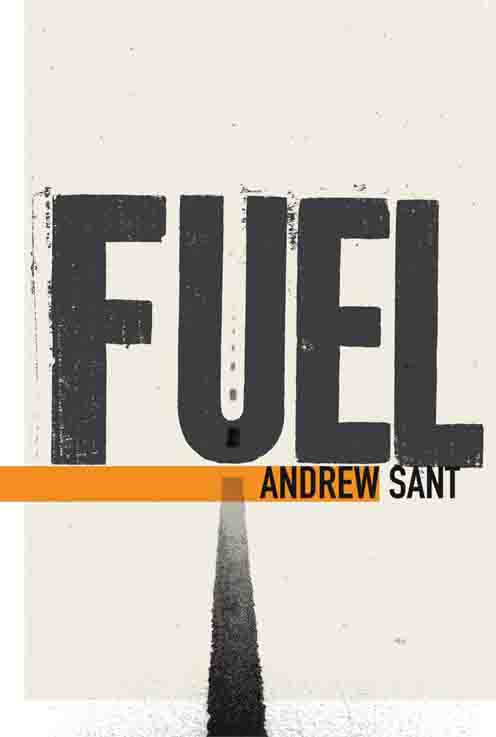
Fuel : Andrew Sant |
||||||||
 |
Book Description In poems that are sometimes celebratory, at other times darkly comic, Andrew Sant’s fascination is with energy as a creative and destructive force. There are combustibles fuelling speed and there is the fuel of desire; food as fuel on a plate and food for thought. Highly visual, rhythmically charged and suffused with feeling, the poems are often set against a background of deep geologic time influencing a present in which puzzled humans—and better adapted insects and plants—are seen to be engaged in their various acts of survival. Fuel represents a journey that begins and ends with water. Sant’s
accomplished, cosmopolitan style gains from repeated exposure.
‘Pleasure’ has been a word much trivialised of late
when
talking about poetry, but Sant’s poems genuinely provide that
all-too-rare commodity.
Nicholas
Birns, Verse
(USA)
In
this remarkable new book... the poems work quickly on the senses, but
the music doesn’t diminish because of this immediacy.
It’s
a work off its leash, and that’s to be celebrated.
Anthony
Lawrence, Australian
Book Review
In
what is now a significant body of work we should see Andrew Sant, in
this new book, in its approachable eloquence and its formal and musical
intelligence as, in his phrase, a new ‘passport into
immersion.’
Adam
Phillips, The Observer
(UK)
ISBN 9781876044633 2009 138 pgs $24.95 |
||||||||
Book Sample
Reviews Andrew Sant - Fuel Geoff Page Island, No. 122, Spring 2010 Andrew Sant. was one of the co-founders of Island in 1979, came originally from England and has in the past ten years or so spent considerable time there. In some ways he is as much now an English poet as an Australian one. This is more apparent than usual in his most recent collection, Fuel. Though there are a few poems which are explicitly set in Australia (Tasmania, in particular) the domesticity and suburbia (even the climate) we feel in the poems appear to be English. Andrew Sant shares with Stephen Edgar, another poet who lias spent considerable time in Tasmania, a predisposition to stand back and observe, to let the relatively mundane phenomena speak lor something more universal. With Edgar, the scene is often littoral; with Sant it is interior. One of these recurrent observers in Fuel is Mr Habitat. He has seven poems devoted to him nominally but his spirit runs through the whole book. He is a somewhat solitary suburban man, bemused by the small things he sees around him and disposed to see them as being symbolic of something rather larger but, even so, less than terrifying. What’s coming is coming, whatever its incredible links to tea leaves or the entrails of sheep. Why take the leap? I think the brave live on the brink ‘Mr Habitat’s Take on the Future’ The book is unified by more than viewpoint and attitude, however. Sant’s syntax and lineation are also very characteristic. He prefers long sentences and, for the most part, relatively short lines. This gives his poems a quality of unwinding, of wending their way down in a deliberately leisurely manner to their final revelation - which, while often low-key, is generally memorable. Sant likes to leave the reader with a last line to chew on. It also creates, in many cases, a strong sense of poise. The mildly erotic poem ‘Knight’ is a good example of the technique at work. Its single sentence runs for eighteen lines across six unrhymed tercets. He begins When I saw her, slender and taut, as if for the first time in the steamy bathroom, turning away from the mirror, so separate, hair still wet, no sudden storm could do it better, her body... Later he says: I look no ridiculous out-of-place steps to protect her because (at the end) in any case she’d meet whatever fiasco, sawily dressed and, as any shield can’t he, readily animated It’s a neat reversal of the damsel-in-distress trope - created almost entirely by the manner in which it’s written. More typical perhaps are poems such as ‘Dedication to a Potter Wasp’, ‘The Household Moth’ and ‘Words with an Ant’ where a narrator or protagonist, observes an ant, a wasp, a moth, a fly, a spider and meditates, in the same leisurely manner, upon them. A few of these poems are genuinely philosophical; most are light-hearted and some downright funny. A good example of the last is ‘The Spider in the Kitchen’ where the narrator begins, somewhat dramatically, ‘I fed the spider beef’. A few lines later her babies are ‘little monsters, big // and hungry.’ A tall teenage relative arrives and swears it is ‘the hormones in the meat’. The spiders, at this stage, ‘stretch... / themselves across wide windows’. The poem ends with a nice ambiguity, a free-standing line in which the narrator says: ‘I looked heartlessly into their eyes.’ Not all of Fuel is concerned with the animal or insect kingdom, however. There’s a playful villanelle called ‘The Marriage Vow’. There’s a convincingly heartfelt elegy for the late British/Tasmanian poet, Margaret Scott. There are several character studies of rather hapless men doomed to English suburbia. ‘Freddy and the Christening Gift’, with its symbolic serviette ring, is one that comes to mind. Something of the same mood can be sensed in the opening lines of ‘High Cost’: In their
garages, obedient cars are like pets drcaming of petrol, oil, speed, highways as beelines to free the use of carboniferous energy. It’s as if young boys want to escape their fearsome primary schoolmarms but There is no getting past them, out of range, buttoned-up dames calling out the lists of name ‘Misses’ The publisher’s blurb suggests that ‘Fuel represents a journey that begins and ends with water’. If water is a symbol of something that goes only where it has to, that is, downhill through the channels available to it, then the image may well be a suitable encapsulation of the book as a whole. What is more the case, however, is a sense, of someone watching the water and pondering its significance in the book’s penultimate poem, ‘Along the Rehabilitated Creek’ the narrator observes with pleasure the wild antics of the birds who have now been able to reinhabit their original environment. ‘The fire finches... / ...light up the scrub.’ ‘A fantail, the show-off, can / put, on an aerobatic display.’ What pleases the narrator most, however, and what speaks for the book as a whole, is the image we are left with of the heron: Only the heron slows right down, motionless at the edge of the flow as if it’s heard of the illustrated Field Guide to Birds, and poses. A full tank Paul Hetherington, poet Australian Book Review, December 2009-January 2010, No. 317 Fuel is Andrew Sant’s eleventh poetry collection. His previous volume was Speed & Other Liberties (2008), which included some of the new poems from Tremors: New & Selected Poems (2004), along with additional work. The epigraph to Speed & Other Liberties is Marc Bloch’s statement that ‘Contemporary civilisation differs in one particularly distinctive feature from those which preceded it: speed’. So, the titles of Sant’s last two volumes imply movement, power, freedom and forward thrust. Certainly, some of the poems in Fuel move at least as fluidly as the often fast-paced poems in Speed, impelled by a rapid accumulation of ideas and associations. There are also other respects in which Fuel and Speed & Other Liberties read as companion volumes. For example, both contain poems in the voice of Mr Habitat, an alter ego for Sant who allows him to write with a sometimes prickly assertiveness. The rhythmic life of Sant’s poetry is various and involving. There are extended poetic sentences; a considerable verbal inventiveness; a quicksilver way with ideas; and a purposeful deployment of devices such as internal rhyme and enjambment. But the poems are never helter-skelter. Sant drives them onwards with care, organising and containing their energy even when he is at full throttle. Sant’s poetic voice in Fuel emphasises momentum in a way that extends the considered measures of the poetry of his first four or five volumes, the pleasures of which were closely tied to its judicious intricacy and carefully observed image-making. But although his mode is more energised (though no less intricate) than in the past, he retains his interest in history, in articulating his sense of being-in-the-world and in questioning the adequacy of language to register complex experience. He writes: ‘Fuel exists, carboniferous heat,/and harnessed water that drives townships,/lit up, into the night; but there’s no energy/as inexhaustible as that seen/in a lover’s eyes’ (‘In the Land Called Desire’). This volume has many such confident-speaking poems that link personal concerns with larger, even global, issues. While some are deliberately lightweight, even jokey, they are all informed by the poet’s attentiveness to the world and by his probing, occasionally mordant, sense of humour. For Sant, issues relating to history, the environment, modernity and the future have always seemed personal. From his first volume onwards, his poetic personae have been close to the world’s concerns, travelling through time and place with a restless interest in what has happened - today and yesterday, in preceding centuries, and even throughout geological time. For instance, in Tremors, the poem ‘Geologist in a Cave’, from the early 1980s, speaks of the ‘Countless strata beneath / the veneer of place’. It is no surprise that Fuel begins with a poem (‘Revisiting Cliffs’) in which the poet ‘whistle[s] out the boy’ in him to climb a ‘wind-sculpted cliff face’, ‘to get at the fossils’. The present, the personal past and the ancient history of the earth intersect as this work considers the vast geological changes that have occurred over the millennia, the numerous extinctions and the continuance of the life cycle, including gulls feeding on the fruits of the sea. Sant finishes with.a characteristically ruminative and encapsulating statement that functions to open up his reflections: ‘What a strange wonder,/on this latest day of creation,/to be human, scramble up/a cliff-face to extract,/with a pick, a bunch of old stones//and look into it deeply for orientation.’ There are numerous poems in this volume about insects and animals. ‘Little Forest Bats in the Foothills’ (‘Their forest/is continuous dark. Spiv-eared,/they listen; wings shrivelled’) emphasises the disjuncture between human research into bats and their natural ‘mapping ultrasound’. ‘The Household Moth’ and the fine ‘Dedication to a Potter Wasp’ explore the poet’s strong sense of being connected to, if separate from, other living things. In the latter poem, Sant’s thoughtful anatomy of the wasp’s activities remind one that a significant part of the poet’s art lies in truly registering what he witnesses. The book’s final poem, ‘Ode To Water’, invokes the work of other writers - including Pindar’s famous ode, ‘Olympian I’, beginning ‘Best blessing of all is water’ - but this poem is pure Sant in the way that it moves from a parody of high rhetorical modes (‘Even the elliptical drip / on the tap, I praise’), to the ironic observation that human fashions extend to bottled water (‘in the shops / - mountain landscapes on the labels - proves / that it’s precious’), to a playful conceptual riff about ‘continuities no spanner/will interrupt when the tap’s fixed’.This poem’s multifaceted conceit turns on the fundamental importance of water: how we take it for granted; how the tap continues to drip; how water can clean, save and enthral. This is a satisfying, shifting and thoughtful volume, charged with ideas, energy and a strong engagement with the world - fuel for the mind. Andrew Sant: Fuel Martin Duwell Australian Poetry Review (online), 1 October 2009 Andrew Sant’s previous (his tenth) book was called Speed and Other Liberties and carried as an epigraph a quotation from Marc Bloch: ‘Contemporary civilisation differs in one particularly distinctive feature from those which preceded it: speed.’ The title of this new book suggests that one of the things it might do is to explore the material which is combusted into producing that speed. And it’s true - fuel and speed do make regular appearances here but they do so from surprising perspectives. Fuel is really more about location, balance, self-awareness and, well, perspective. Sant’s recent poetry seems, to me at least, to be happy to avoid those things which knock us out of balance, things such as erotic love, transcendence and the arrival of the divine in the form of visitations. It is humanist, in the old sense of the word, in that human life is at the core of its concerns, but it has very little patience with the tendency to inflate the significance of that human element. A good example of these interests is the first poem of the book’s fourth section, ‘The Promethean Gift’. As the title tells us, it is about fire and, in this respect, it balances the section’s final poem which is about water. In ‘The Promethean Gift’ humans are situated between fires and lizards in terms of their need for fuel: In appreciation of this, I raise a whiskey, and to friends who, unlike hidden lizards in the woodpile, as a species need ready fuel. The fire is keen about this, like smoke in clearings before humans moving coldwards cleared more and more... In a sense this issue is taken up again in a series of poems called ‘Cycle’. In one of them the image of the human flanked by the fire and the lizard is repeated. The wood-burning fire has a fast metabolism, faster than that of its human owner and feeder, but the lizard which has been hibernating in the sawn up logs has one which is slower than either: When it slid its few burnished inches into the open, the skink unfroze a trick rehearsed in the Triassic of riding idle with the inanimate while woodsmoke showed whose metabolisms aren’t for slowing... So the volume of demand for fuel and the speed of its consumption, not to mention the activity of the heart, is one of the ways this poetry wants to situate us: what one might call a biological positioning. But there are many others. And one of the most attractive throughout the poems of Fuel is the drive toward fitting us into geological frameworks. The first, very fine, poem, ‘Revisiting Cliffs’ specifically contrasts our sense of the elapsing of time with geological time. Clambering up cliffs in the search for fossils, the adult man thinks about the boy in him and about the passing of a few decades that makes the massive change from child to man. But the act of climbing is taking place over sedimentary rocks which cover millions of years and contain, between their strata, fossils which themselves contain a ‘glimmer’ of the mammals which we will eventually evolve from. So the growth of a single human is also set in the context of evolutionary growth that goes back to the Jurassic. The end of the poem is interesting: What a strange wonder, on this latest day of all creation, to be human, scramble up a cliff face to extract, with a pick, a bunch of old stones and look into it deeply for orientation. The word ‘wonder’ (which appears twice in the poem) has a suggestion of the miraculous which the poems of Fuel generally avoid, though there exist, of course, perfectly secular wonders, such as looking at images from the Hubble telescope. But the search for an orientation is close to the heart of the book and another good poem, ‘Rock Music’, takes up the geological theme, operating, as many of the poems do, in terms of contrasts. There are two kinds of rock music: the stuff that comes out of the radio - absolutely up-to-the-minute and focussed completely on the present - and the strange sounds made by rocks themselves. If you switch off the radio, the poem says, you can attempt to tune into ‘the frequencies of stone’ working through sandstones, schists and flint:
Elsewhere you, as audience, facing Triassic strata, may get transported by sediments bound together like pages that predate the break-up, layers of the supercontinent Pangea. Ultimately you arrive at a meteorite in a museum which ‘signals, mysteriously, all / it can about how life modestly began’. ‘Rock Music’ has the attractiveness of being a comparison built into a single phrase in the title. It’s not a powerful poetic technique but it is one of the things that Sant is good at and it lightens and animates the poems. To be without direction is to be ‘all at sea’, for example, and one of the poems, ‘Mr Habitat at Sea’ exploits this (Mr Habitat is a kind of alter ego whose experiences fill out a dozen poems of what looks to have been, originally, a sequence and is now spaced out throughout the poems of Speed and Other Liberties and Fuel). A small but intriguing poem, ‘The Misses’, invokes the formidable teachers of primary school but is really interested in the way that formal education contrasts (or, perhaps, complements) the immersion of informal education: There were fields, seasons containing forever, to quicken in; nests, eggs, chicks in the hedges - grazed knees, open space. As well there were the firm Misses at the beginning of our formal educations: I remember Folkes, Powell, Josa. What you get from the formal component of your education, the poem wants to say, is identity, location and orientation. Contrast, the way Sant’s poems use it, is not a way of correcting (one road wrong, the other right) but of locating. The second poem of the book, ‘Two Fisherman’, is built from an intriguing contrast. For the first man, fishing is a social activity and takes place on a petrol driven boat fuelled, metaphorically, by dreams of the big pelagic fish out beyond the harbour. He gets a single thirteen-line stanza, as does his counterpart: Fisher two is stationary, with a heron’s patience, edge of a lake, and if there’s no strain on the line, nod of the rod towards promise, there’s meditation. He waits, winds in the fly, casts and recasts a gossamer arc. The lake is corrugation, then it is glass. Or in his boat he stays put, anchored as he might be at a bar, looking dreamily to see what might happen, beyond his beer. The trout is elusive, tactics and a Sunday gambled might win it. The man’s moves are sudden, spiderish. He’ll use many old tricks till, by nightfall, he too may be spent. Eleswhere, women later might surface. Two approaches to life are set up here and both seem viable - neither at least is explicitly condemned. One blasts through its element in search of fulfilment, the other floats patiently on it. One works by capture, the other by luring; one by action the other by stealth. A more significant matter, may be the ambit of the allegory. Do these men represent approaches or life or approaches to poetry: fishing - using lines to bring strange things up from the depths - has been a metaphor for poetry long before Seamus Heaney got out his fishing rod. And the issue of what licence readers have to read these poems as allegories about poetry itself extends to other poems in the book. ‘Two Fishermen’ is followed by ‘Marvellous Harbours’, which is also, at heart, a contrast poem. It juxtaposes open, wild water with enclosed water; the fishing boat’s arrival with the tourist liner’s, the view from the harbour’s surrounds and the view of the harbour from the ‘cannon level’ of approaching boats. One wants to read it as being, like the fisherman poem, about open and enclosed, raw experience and calm processed experience. This makes it seem an allegory of ingestion, always something close to poetry and its response to experience. And then there is ‘Dedication to a Potter Wasp’ contrasting, on the one hand, the torpor of a poet from temperate climates who has finished up in the tropics and, on the other, the remorseless energy of the wasp which goes about building little clay poets for its eggs and filling them with paralysed caterpillars: Nine cells I’ve greeted - two already set hard when I arrived as a guest - each deftly erected during slack afternoons or treks from the house; the lot being rendered - this northern wasp cannot stop! - smooth as a pot, while I, sluggish in the tropics, praise this maker, now pack to fly in pursuit of the south. ‘Maker’ in the last line signals ‘poet’ but, apart from that, I suppose there is no really compelling reason that it should be read as a contrast of the productivity of two poets. In fact, given the rest of the poems in the book as a kind of interpretive context, it is most likely that Sant is interested in contrasting the metabolisms of the wasp and the human. The poem that perhaps best sums up this interaction between biology and geology, between fuel and perspective, is ‘Heart on a Summer Afternoon’. Here Sant addresses his own heart, beating rapidly after climbing (as in the first poem) to a place where there is a perspective, ‘a view / to die for, if you’ll excuse / an expression that smacks / of conflict.’ Again, the place of perspective leads to a meditation about where humans fit in the scales of things and here it is the swallows, so fast that a ‘target summer fly moves / like a Zeppelin in their sight’, which contrast with the human. If the wasp was dogged application personified, the swallow is a frantic life-in-process: Now I have my breath back, many thanks, quite steady along, I guess, with the swallows’ intake as they swoop, squeal, and rise above the house, all thoroughly in the present, unlike the slow, reflective humans on the path. The poem finishes with an acceptance of torpor in the summer heat and locates the evolutionary origin of the human heart in African warmth, rather than the paleolithic conquest of the cold forests of Europe: The African beat you keep in my chest is great; we’re sunned and fed - as if, in this equatorial heat, vast Europe might still be the risky domain of strange primeval forest. Fuel is, as I said initially, largely about the implications of a humanist view of existence and perhaps prizes perspective as the ultimate gift of the self-knowledge that derives from this. I said it was a book without much interest in those potent experiences - erotic love, epiphanic experiences of the divine - which disturb that humanist position. That was a little misleading since there are poems which focus on these issues but the fact that they seem unusual poems in the context of the book actually supports my case. The erotic appears in an odd and intriguing poem, ‘August’, where, after extended descriptions of place and an extreme sensitivity to perspective - an aeroplane’s view is imagined and then a hawk’s or eagle’s and then that of the lowly oystercatchers at the ocean’s edge - two lovers appear on the beach, significantly described in evolutionary terms as ‘late arrivals’. The intention seems to be to see erotic intensity from an evolutionary perspective and the poem finishes:
We might be headed, right now, arm in arm, down a platform at a grand station, lovers pressing forward through a crowd in the Age of Steam. And there is another poem, ‘In the Land Called Desire’, which is also about love, setting up an allegorical landscape where mountains are mere blocks to fulfilment and the streets of the town have one mission which is ‘to offer rapid passage’. It remains a very Sant-like (Santly?) poem though in its interest in what fuels the erotically charged heart: Fuel exists, carboniferous heat, and harnessed water that drives townships, lit up, into the night; but there’s no energy as inexhaustible as that seen in a lover’s eyes while crossing a bridge or square... And, finally, there is a puzzling poem, ‘Visitants’, about, as its title says, visitations. A door slams and the house’s owners think in terms of ghosts. The author, a visitor himself (hence the plural title) sees a raven land clumsily in a tree and is of the opinion that the bird is the cause of the various goings on, falling leaves on a windless day, and so on. I don’t feel completely confident about this poem but I want to read it as an assertion that there is a logical answer to the phenomenon but that that logical answer - the raven - is, seen from the right perspective, a miraculous one because life itself is miraculous. A human-centred view of life is a complicated one for poetry since it removes as a motivic force the power of the numinous. Visitations are phenomenally powerful poetic (as well as personal and cultural) experiences. Poetry itself is also, of course, a power in the human-centred universe and Fuel doesn’t seem to focus much on this - at least not overtly. But what can be said about the poems of Fuel is that they are never reductive and are very alert to what that first poem calls the ‘wonder’ of true perspective. Andrew Sant, Fuel John Lucas Critical Survey (UK) Fuel is high octane, though a few stray impurities have got through the filter. Chief of these is an over-use of ‘ever’ to mean ‘always’, as in ‘ever ready’, ‘ever on the move’, ‘ever renewed’, ‘ever restless.’ I can see why a poet whose language is characterised by such quick-paced energy doesn’t want to waste time on the dragging sounds of ‘always’, but the alternative, when repeated as often as it here is, can be ever-so slightly irritating. As can the habit of pushing two assonantal words against each other in a kind of stylistic tic (You see how habit-forming it is!); ‘guests expect’, ‘nifty shift’, ‘core, swore’, ‘script ripped’, ‘sensibly fenced’, ‘test/pest’, ‘note/known’, ‘creek/leans’ and plenty more. The fact that the last three examples involve enjambments doesn’t prevent me from thinking this habit needs to be reined in. Enough already. And yet it is, I guess, the price you pay for Sant’s linguistic exuberance, a delight in handling words that makes Fuel a bravura performance. John Wain once said that to write a poem ‘you have to be a bit above yourself’, and Sant’s collection feels on a perpetual high. It is certainly the work of someone in love with what poetry can be made to do. Individual poems, different from each other as their ostensible-subject matter may be, are, as a theorist might say, ‘performative’. Here, for example, in apparently skittish mode, are the closing lines of ‘Words with an Ant’, in which the insect has gone out on a limb,
risked it, advanced briskly, thanks to a killer pencil, into the zone of a poem that’s neither reflective nor earnest out of respect for expression that likes - and swiftly follows - your bite. A snuff poem! The adroit playfulness of this is in the handling of line breaks and of syntax (the deftly positioned ‘thanks to a killer pencil’), the linked sounds that track through the lines - limb, risked, briskly, killer, reflective, respect, expression, likes, bite. Not that this is any comfort to the ant. And snails can take equally little comfort from ‘High Cost’, which begins ‘In their garages, obedient cars are like pets/dreaming of petrol, oil, speed,/highways as beelines to free/the use of carboniferous energy’ and ends with a warning to snails that they ‘should quickly take/into consideration the fact/that I can easily nab them and,/if they still don’t see things my way,/the considerable impact my boots/will have on their preposterous habits.’ And at this point you idealise that Fuel is by no means merely playful. If, as the blurb rightly says, ‘the poems are often set against a background of deep geological time’ - though ‘background’ hardly does justice to the way such poems are grounded in geological history - it is also true that Sant takes as read that we live in a world of aggressively competing egotisms. The voice that emerges in ‘High Cost’ is after all fascistic, and while to ‘nab’ a snail seems to soften the will to power, the boots’ impact on ‘preposterous habits’ is intended to crush the opposition. Cars, on the other hand, whose fuel consumption represents a terrible threat to the green world, are ‘pets.’ I had to read Fuel twice before grasping how subtly Sant handles this serious matter, how the collection in fact makes a distinguished contribution to what is now often called ecocentric poetry. For Sant, this doesn’t so much mean genuflections to the green world as a wry, slanted awareness of the battles that go on between the human and the natural, as in ‘Eradicating Ivy’, in which a ‘Gloves off, then gloves on’ struggle for supremacy concludes with the admission of ‘towards ivy - now in heaps -/a hard-won attachment’, or ‘Dandelions’, where, as the children ‘blow off seeds’, the gardener thinks it ‘high time’ that their advance should be arrested, though he is ‘annually defeated’, and his insult is ‘to call them a weed’. (As Clare knew, ‘weed’ has no botanical meaning: it s simply an unwanted plant.) Or there is ‘The Mosquito Satisfaction Wrap’, a tour-de-force one-sentence poem that unspools over 42 lines, registering satisfactions that include ‘a superlative crap, better than/at last, sneezing though not better/than a Belgian wheat beer straight from the tap’, until we arrive at the final one: that ‘driven proboscis [which] draws sweet blood,/a slow stoned-eyed gutful, till she wings/clear of itch, and trickily of vengeance,/her parting gift to the diminished victim.’ Winging clear, lifting off, is how Sant characteristically operates. In one brilliant poem he contrasts his role as apparently casual but in truth fully engaged observer of the ceaseless endeavours of the potter wasp - ‘nine cells I’ve greeted - two already set hard/when I arrived as a guest’ - determination and persistence which cause him, ‘sluggish in the tropics’, to ‘praise/this maker’, as he himself packs ‘to fly in pursuit of the south’. Always in pursuit, but never at rest for long. Hence, the equally brilliant ‘The Round’, with its epigraph from Weldon Kees, ‘restless forever, and quite indomitable’, which begins ‘Mid-week, he left’ (nothing predictable about this man), and whose last stanza runs There must be, he thought, an end
To this other than in a strange city where his life again would be recast. He packed - and soon was back to try on for size what some found vast, The one he’d quit. It didn’t fit. This isn’t however the poet as Banddanan flâneur. Sant’s essentially modernist stance reminds me more of Isaac Rosenberg, the first Anglophone poet to direct his gaze, unwavering, sardonic, full of fascinated - and appalled - wonder, at the breakable world, though what Rosenberg had to register was far more terrible than anything that comes within Sant’s jauntily viewed perspective. Sardonic he may be, but this doesn’t cancel affirmation, as in the collection’s final, Redgrovian and ample ‘Ode to Water’. Put it another way. Fuel shows that modernism isn’t merely, or mostly, a matter of rebarbative forms and modes of address. Inverse perspectives on the maturing voice [reviewing Fuel and Wimmera by Homer Rieth] Geoffrey Lehmann The Weekend Australian, 7 November 2009
Why do some poets, like some people, do their best work early, and
others continue improving and peak in their late 40s or 50s? While
editing an anthology of Australian poetry, this has been on my mind.
Kenneth Slessor, Henry Lawson, Christopher Brennan and Banjo Paterson
had virtually exhausted themselves as poets by the time they reached
40. But Slessor’s friend, R.D. FitzGerald, matured as a poet
only after
reaching that age.
Goethe and Yeats continued developing until late. For male poets, at least, it may be necessary to have an argument with oneself if one is to continue developing. Goethe rejected the romantic storm and stress of his youth, and embraced classicism and balance. Yeats rejected the lushness of his early poetry for a language that was stripped back and closer to everyday speech, the famous ‘cold eye’ of his epitaph. With female poets, a decision to have an argument with oneself may not be needed. Biology may force the issue. When reading the poetry of Elizabeth Riddell, one of our good middle-ranking poets, I was struck by how free her poetry became once she reached her late 40s, as though a burden had been lifted from her. Jennifer Maiden, one of our best contemporary poets, has even written a poem about it, ‘Menopause as a Bee Freed from a Fairy Floss Machine’. The title of this stunningly good poem says it all. Both books, Fuel and Wimmera, are the work of mature poets. Andrew Sant was born in London in 1950 and came to Australia with his parents in 1962. Homer Rieth was born in Germany of German and Georgian parents in 1947 and came to Australia in 1952. Both poets are published by Black Pepper, founded by the feisty Kevin Pearson, himself a noted poet. Black Pepper is one of the livelier new houses that has sprung up after the large publishers decided to exit poetry publishing. That’s about where the similarities between Sant and Rieth stop. Sant has a long publishing history, going back to 1980; Fuel is his 11th published volume of poetry. He writes short, mainly domestic poems, and is able to tease significance and a sense of profundity out of everyday things with wit and ingenuity. Although a few years older than Sant, Rieth has a short publishing history, starting in 2001, and Wimmera is just his second published volume of poetry. In contrast to Sant’s short poems, Wimmera is a single epic of more than 300 pages, a leviathan of a poem, cosmic in its ambition and symphonic in its approach. In 1983, as editors of an anthology, Robert Gray and I wrote: ‘Sant’s poetry seems very English in its reticence and use of the middle tone of voice. He always deals directly with experience... His strength is his interest in and close observation of other people, combined with a classical openness of style and freedom from affectation.’ These comments about Sant in 1983 are still true, except that his syntax, which was always a bit complex, has become more complex and circuitous, and his poetry is drier in tone; perhaps too dry and sinewy at times. He has continued to grow and develop as a poet because his poetry thrives on wit and intelligence rather than on hormones. Take ‘Rock Music’, for example, a poem not about a type of popular music. It’s about ‘the frequencies of stones’, the music of geology. Sant is a poet of precision and imagination. In ‘Given’, after the inaction of listening to the news and hours at a computer, he starts digging in the garden: Gigantic, the fresh spadefuls
of planet; wrecked worms like swimmers fighting incredible turbulence. His adoption of the
worm’s viewpoint and his choice of the word planet are quite
remarkable. Perhaps the pick of the poems in this book is his elegy for a fellow poet, Margaret Scott. ‘The Fires’ also may be a poem of farewell to Tasmania, the island where he has spent much of his life. Flying out of Tasmania over a bushfire, he thinks of Margaret Scott, two of whose houses were incinerated in fires, and who always said to him, in a motherly way between cigarettes, ‘Now tell me what you’ve been doing/and where you’ve been.’ He also remembers how Margaret used to keep herself awake while driving at night by repeatedly shouting, ‘Elephants! Elephants!’ Rieth’s first volume of poetry, The Dining Car Scene, published when he was in his 50s, was an elusive book. The title poem was a virtuoso piece describing with great precision a scene from Alfred Hitchcock’s North by Northwest. But it was hard to make out what he stood for. Rieth has been a teacher of Greek and Roman literature and the one thing that was clear was his love of language. Wimmera is an extraordinary poem, comprising 12 books, each of two parts. Rieth moved to Minyip in the Wimmera district of Victoria in 1999. At a basic level the poem reflects Rieth’s feelings for a landscape and people he has come to love. Each book, we are told in an introductory note by Justin Clemens, ‘moves through the experience of a particular place: discoveries, establishments, characters, events, the contingencies and violence of settlement and the unexpected profusions of the natural environment.’ The poem reaches its climax in part one of Book 12, where Rieth moves from the profusions of drought and flood of the Wimmera and addresses the ‘countless curvatures of space/an atoll of time in an ocean of infinitude/the starry night is no more than time/only space only/the inaudible overheard’. The long, sinuous sentences of the poem have passages of bravura language. This is how Rieth summarises the life and death of poet Adam Lindsay Gordon: ‘trooper Gordon... between poignant poems/... had seen how over the jumps a horse instinctively picks up a/certain tempo/by the time it covers the distance the tempo has become a heartbeat/tbe grace of its motion almost supernatural/and yet he shot himself as if the shot ringing out might make for/the sound of a caesura’. This technically brilliant passage reveals one of the weaknesses of Wimmera. Gordon’s tragic suicide is treated almost flippantly. The consistently heroic tone of the poem, although it knits it together musically, sometimes places too great a distance between the reader and details that might have engaged our sympathy. My second grouch is the deliberate use of cliche, such as ‘drunk as skunks’, ‘back of beyond’. I realise that the father of European poetry, Homer, also used cliches such as ‘wine-dark sea’ but that does not justify their use here. Notwithstanding these faults, Wimmera is quite extraordinary: it reads like a young man’s poem, with its ebullience, panache, occasional passages of juddering bathos, and its hormonal music. Anthony Lawrence 10 December 2009, The Railway Hotel Andrew Sant writes his poems by hand, with a pencil. I love reading these poems, in their various versions. His handwriting is immaculately crafted, like his poems. You can almost hear the graphite at work on the paper. He spends weeks, sometimes months on a single poem. When his new book Fuel arrived, I opened it at random and read ‘Lift’: I check the drift
of a word to relieve the weight of losing it and, suddenly, the worn dictionary seems so heavy, like a rock that turns out to be ore— the odd stratified word making a comeback, cocky among the dumped. Nearby, contractors bulldozing a lake of clay call subterranean boulders ‘floaters’ as they surface and, definitively, stay. You couldn’t ask for a better introduction to a new work. Here is a poem perfectly contained, both visually and syntactically, yet sparking at the edges with energy. I love ‘the drift of a word to relieve the weight of losing it’. This is the kind of finely-crafted music I know and love in Andrew’s work. There has always been the familiar, engaging, tight lines and sharp observations, both domestic and international; the quirky and light-hearted sharing blood with the bleak and uncompromisingly serious. The difference between his earlier work and the poems of the last six or seven years, especially in Speed & Other Liberties and Fuel is that there is now a dovetailing of control with unshackled imagination. This new book is overbrimming with poems that take risks and know exactly how far to extend them. Take ‘Craquelure’: Not being a soft habitué
of the halls of high art, the man with the battered sweat-stained hat—and, miles back, his family given to spending evenings on the verandah, thanks to slim financial readjustments at their bank— surveys his land, squints at fly-blown, bony sheep as was ordained in better days by past generations when promise falsely rained, cannot necessarily see, though he sees all, that a network of cracks on brown land where the water’s evaporated stress an affinity with the portraits of Leonardo or Vermeer, the intricate cracking on their paintings beyond being halted or, by the desperate, faked. Andrew has interwoven the mud cracks around the rim of a dam or creek bed with the age-lines on paintings. It’s a masterful poem, dealing with a harsh rural life and culture, reality and what’s been faked. The deep imagist Ted Kooser, whose work we both love, couldn’t have done it better. There are many short, lyrical poems in this book, and for me this is one of its real strengths. They are hard to write and only the best remain in the head and under the tongue. There’s a stunning villanelle, too. ‘The Marriage Vow’ is a brilliant example of my earlier comment regarding Andrew’s ability to dovetail the deadly serious with genuine humour. Being a hardcore lover of the sea, and of fishing, there are poems that satisfy this reader’s passion. ‘Two Fishermen’ brilliantly portrays two kinds of fishing: the hands-on, action-filled, loud and unsteady world of game-fishing, and the artful, quiet, meditative world of trout fishing. I read it as a metaphor for writing poetry: the initial burst of imagination, getting words down, running on instinct, reading the signs; and the slow, deeper meditation of editing, crafting lines into place, getting the line-breaks just right. This poem is followed by ‘Marvellous Harbours’—it’s a muscular, detailed, musical celebration of difference and singularity, and it contains some of my favourite lines in the book: ...the streets like cordage
wrapped firmly around water and motion, town driven by wind and the boats on petroleum— the harbourmouth, wide or a devil, to the wide world always open, spotted first at sea quest and cannon level, beating hollow the casual, elevated pleasure of seeing all that has followed. It takes a lot of deep dreaming and a finely-tuned ear to make music and phantom rhymes so good. ‘Dedication to a Potter Wasp’ combines a microscopic view with a binocular one, a wide sweep of colour and layering interspersed with fine, intimate detail. I love wasps, and this one gets it absolutely right. Human wonder with objective understanding. Fuel is filled with animals, birds and insects: mosquitoes, flies, snails, wasps, spiders, mice, beetles, oystercatchers, bats, fish... They appear as either central, driving images, or they come and go, splinters of metaphor around which the lines rise and fall. The book has four sections, each meticulously planned. To have sections in a book of poems is one thing, to craft with great attention to detail where each poems falls, and to do this successfully, is another thing entirely. Andrew has managed this balancing act well. The poems that speak most clearly and forcefully to me about this collection as a whole, are ‘Rock Music’ and the sequence ‘Cycle’. They are marvelous examples of how metaphor and pared-back, deceptively simple language can captivate and inspire us. I love these poems for their eloquence and wisdom, their shape on the page, their hard-won, stunning rhythms. Over to you, Doc, for the 100% proof. | |||||||||