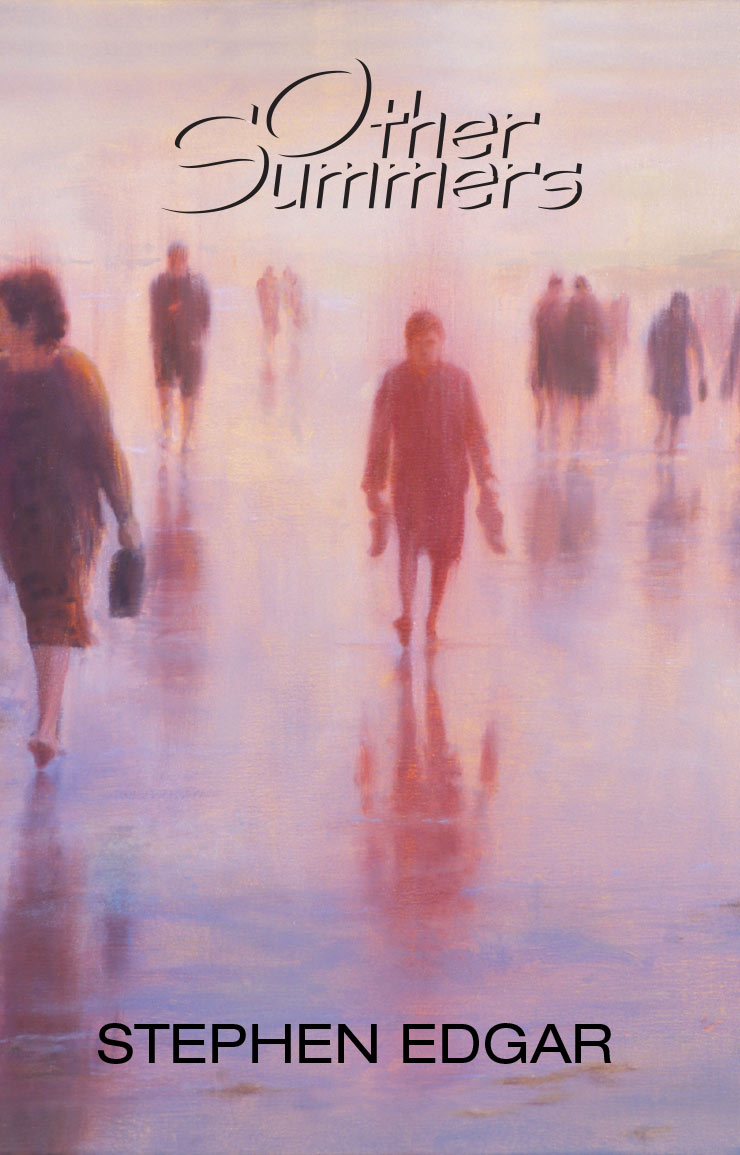
Launch Speech
Peter Steele - Poet and
scholar
10
March 2007
Ladies
and gentlemen, I had considered confining my remarks today to saying,
‘Stephen Edgar’s Other Summers is so good a book that I don’t know what
to say about it, beyond recommending that you read it,’ but I guessed
that you would think that something more was called for.
When,
with pleasure, I began some years ago to read Edgar’s poetry, an early
reaction was, ‘Somebody has been reading Anthony Hecht.’ From my point
of view, this was a very good sign - not only because as it happens
Hecht was a dear friend, but because I had long admired a number of
elements in his poetry. Stephen Edgar’s work does not in any sense
replicate Hecht’s poetry, but it may be useful this afternoon to name
several features of the American’s writing which point us towards
Edgar’s poetry.
The
first of these is a fascination with the enigmatic and the transient.
One book of Hecht’s is called Millions of Strange Shadows, another, The
Transparent Man, and he wrote many poems in which a central motif is
the evanescence even of the vivid. And while titles are not necessarily
guarantees of anything in particular, consider some of the titles of
Edgar’s poems in Other Summers: ‘The Immortals’, ‘Tomorrowland’,
‘Unsunned’, ‘State Secrets’, ‘From the Labyrinth’, ‘The Sorcerer’s
Apprentice’, ‘Optical Illusions’, ‘Against My Ruins’, ‘Night Vision’,
‘Never’, ‘Diversionary Tactics’. And indeed it proves to be a fact that
what Edgar’s strikingly expert verse steadies in the mind is an
awareness of unsteadiness, of the ‘going... going...’ of things which
refuse nonetheless to be gone. This is a paradoxical state of affairs,
but Edgar has little interest in tricksiness: it is rather a question
of his trying to keep faith poetically with that strangeness of the
world which is attested by his sensibility and framed provisionally by
his intelligence. The Irish poet Dennis O’Driscoll remarks that’The
talent many poets share is that of making the ordinary seem ordinary’:
that is a talent which Stephen Edgar does not enjoy.
O’Driscoll
has also remarked, ‘Poetry is my preferred language. Music is poetry’s
preferred language,’ which points us towards an important feature both
of Hecht’s and of Edgar’s work. I am thinking here of the frequency
with which each of them uses music as motif or as implied context - as
in, say, Hecht’s ‘A Lot of Night Music’ or his ‘A Love for Four
Voices’, or as in Edgar’s ‘Song Without Words’ or his ‘The Sounds of
Summer’ - but more importantly of that latent musicality of all
warranted precision in speech, of the buoyancies and cadences which
seem to sustain the phrasings by which they are themselves sustained.
Open ‘The Immortals’, the first poem in Other Summers, and this is how
it begins:
A
breeze fills up the manna gum's huge lung,
That
hologram of bronchioles. It sways there
Tethered
and shifting like a hot-air balloon
Preparing
for some fresh and doomed attempt
To
circle the great globe. Heaped at its base
The
litter of shed bark and collapsed boughs,
So
much dumped ballast...
In
such a passage - and passage it is - the pentameter is in effect a
rudimentary keying of attention through which there play, in point and
counterpoint, phrasings of insight and fragments of lyricism - as in,
‘That hologram of bronchioles’, or as in ‘Preparing for some fresh and
doomed attempt / To circle the great globe.’ This poem is not one of
those in the book which most overtly reach for musicality - they would
include, say, ‘The Transit of Venus’ and ‘The Implicate Order’ - which
is part of my point. It is as if, for Edgar, the world is constantly in
audition, constantly being assayed for its fitness to be heard into
life, whether it portends good news or bad, or the customary mutual
suffusing of the two.
That
mention of ‘good news or bad’ reminds me once more of a salient feature
of Anthony Hecht’s poetry. Countless Australians, once upon a time,
taking their cue from Dorothea Mackellar, attributed to this country,
‘her beauty and her terror’, and Hecht found the matrix of his
imagination in a convergence of the beautiful and the terrible. He was
often, to use the word with some precision, a tragic poet, though he
did not suppose that this committed him to a poetic austerity. Stephen
Edgar, writing in the remarkable sequence ‘Consume My Heart Away’ of
love found and lost, says at one point, ‘I took all that you said as
true / But what is true is more than what is said, / And maybe after
all your years of practice / Your body’s mastered how to lie in bed’,
and then at the end of the same poem, ‘Tralee’,
No
rules, but consequences should be clear.
To
hear on that last morning your
Last
words, ‘Think of the good things, let’s be friends,’
As
though a wounded heart’s a frippery,
As
though love’s really ended when it ends.
The
path we took was no detour.
There
is no other way. And oh, my dear,
If
you still think that we might reach Tralee,
The
truth is that we cannot start from here.
There
is enough and to spare of the terrible in both of these passages, but
in one way they are not austere, in that the bitter wit of the first
has a beauty of its own, and the second’s blend of seasoned wisdom and
thwarted aspiration is carried melodiously.
The
prompting human experience that lies behind such poems is no doubt, to
put it mildly, demanding enough: but so in another sense is the
aspiration to do some kind of real justice to it in poetry. If there is
one thing more than another that I admire in Stephen Edgar’s poetry it
is that, while he plainly has a virtuoso’s expertise in the disposition
of forms, he is so constantly open to what Yvor Winters called ‘the
rain of matter upon sense’: he wants the reader to see the rain quite
as much as the gleaming buckets in which it is being collected. James
Richardson asks, ‘Why would we write if we’d already heard what we
wanted to hear?’ and says, at another place, ‘Only half of writing is
saying what you mean. The other half is preventing people from reading
what they expected you to mean.’ Together, such sayings warn against
taking it easy in poetry, since there, too, easy come, easy go. It is
not a practice to which Edgar is given.
I
claimed earlier that Edgar’s imagination inhabits the enigmatic and the
transient, and perhaps that is the note on which to end, provided that
one notices the alertness and the achieved proficiency with which he
lives there. He writes as though it is possible to be at once a veteran
and an innocent, and reading him, very often, one believes this. Late
in his poem ‘State Secrets’, it is a veteran's voice which acknowledges
that ‘The folded rose / Is now too intimately classified / For any name
that named it to disclose’, but the innocent is there to be heard, too,
in the poem’s final stanza:
Astonishments
of time and light,
The
source of feathers, the atrocious doubts
That
flood the bloodstream are too recondite
For
you. The last kiss on the brow,
What
love becomes, your father’s whereabouts,
Once
whispered - these are all State secrets now.
Stephen
Edgar is a broacher of such secrets, and Other Summers passes them on
authoritatively. It is a pleasure to declare this book launched.
Reviews
Other Summers
John
L. Sheppard
Five Bells, Spring/Summer 2008/2009
Stephen
Edgar has often been regarded as Australia’s foremost
formalist. The collection of poems in Other
Summers,
his sixth book of poetry, only serves to strengthen this reputation. It
is evidence of a master craftsman at work. He uses rhyme, but not in
every instance; he often has regular stanza lengths, especially four or
three lines, but not always; he sometimes uses known classical forms,
like sonnet and villanelle. However, it is not the structural aspects
that make his writing compelling: it is his elegant use of language and
his sophisticated lyricism, often expressed in free verse.
Here
is an example of this elegance of expression, compacted with
metaphor, carefully chosen adjective and personification:
The day unfolds its golden
auguries
On a charmed
sky. A
secular congregation
Is out
already to revere
The lit east
with a
helpless expectation.
‘Tomorrowland’
And
in another extract, also compacted with metaphor, and with simile:
A breeze fills up the manna
gum’s huge lung,
That
hologram of
bronchioles. It sways there
Tethered and
shifting
like a hot-air balloon
Preparing
for some fresh
and doomed attempt
To circle
the great
globe.
‘The Immortals’
One
of my favourite poems in the book is ‘Salvage’. It is
the extraordinary poetic power of the language that attracts me, and
the dramatic quality in Edgar’s imagery. Consider the following:
And when the winches
Shriek and
groan in
concert, and the chain winds in,
And the
churning
surface, growing smooth now, shows
The green
emergence of a
rising bulk
And bulges
momently like
a streaming eye,
And
something broaches,
oceanwater-curtained,
What would
it serve
them, even if they could see,
Whether the
deeps fall
dazzlingly away
Like foamy
gauzes
trailing Aphrodite,
Or spill
like eels out
of a rotting horsehead?
‘Salvage’
The
verbs are highly expressive, indeed onomatopoeic, in
‘shriek’, ‘groan’ , ‘bulges’,
‘broaches’; the adjectives are intense, in
‘churning’, ‘streaming’,
‘oceanwater-curtained’, ‘foamy’,
‘rotting’; the similes are startling, in ‘like a
streaming eye’, ‘like foamy gauzes trailing
Aphrodite’, ‘like eels out of a rotting horsehead’.
There
is also a rhetorical flourish in the writing, where the lines
build up to a climax as the repeated ‘and’ (given five
times) adds one image after another, until there is the ‘What
would it serve them...?’ This build-up gives the writing special
strength and purpose, just like an orator may use repetition to make a
powerful point.
The
reference to Aphrodite (p.73) reflects the author’s classical
background, for he is a Latin and Greek scholar, and occasionally
alludes to the ancient myths; for example, he refers to Beatrice (p.2),
Andromeda (p.10), Ithaca (p.19), the Minotaur (p.36), and Sappho the
writer (p.ix). It helps to know your classics. It also helps to know
your literature; for example, Edgar often refers to Dante, and has
allusions to several other writers.
Another
part of the book I find intriguing is his treatment of a summer
theme in three different ways under the same title of ‘Im
Sommerwind’, which is a German term. In the first and third
rendition he addresses the same general scene of his family home, with
mother and author present, but deliberately describes it in different
tones. I asked him about this, and he said he just wanted to try it out
in a different way. I am reminded, having just been to the current NSW
Art Gallery exhibition, of how the French Impressionist artist Claude
Monet in the 1880s and 1890s painted several series of the same subject
in different light, as changes occurred through the day. One of these
was of the Creuse Valley, another was Rouen Cathedral, another was
haystacks. He thereby produced an extraordinary sequence each time.
Edgar is taking the same approach of viewing the one subject in
different lights, for the sake of making the comparison. All three of
the poems are in triplet stanzas. The third is in chained verse, a
villanelle. The first line is the same in the first and third poem. The
second treatment is very different in approach, seemingly based on a
photograph of his family, and acknowledges an extract from Primo Levi
which has in it the themes contained in Edgar’s own poem.
There
is a certain artistic playfulness in this approach, of producing
a triptych and scattering the three parts to different locations in the
book, not side by side, leaving it to readers to find what they will.
We see here Edgar’s versatility. The three pieces bind the book
as a whole, setting up thematic unity. One can compare the beginning of
the first poem and the third:
On a hot listless Sunday
afternoon
Of
adolescence, on the
parapet
Of cooler
brick on our
front porch, propped up
Against the
pillar I
look lazily
Across the
park that’s
faded less by summer,
It seems,
than from the
day’s inert aversion
To the
principle of
colour, as when you stare
Directly at
the sun,
then turn away,
And
everything is washed
out, overexposed -
‘Im Sommerwind’
*
On a hot listless Sunday
afternoon
I’m
sprawling on the
porch by the front door
While
someone’s radio
murmurs a tune.
My mother’s
brought a
chair out to maroon
Herself a
moment between
chore and chore
On a hot
listless Sunday
afternoon.
The screen
door wants to
let the house commune
With languid
airs that
stray in to explore
While
someone’s radio
murmurs a tune.
‘Im Sommerwind’
The
first poem is in free verse; the third is formalist, following a
tighter set of rules. Both versions work; both are competently crafted.
All three are founded on reminiscence.
It
is intriguing to relate those three poems to a fourth in the
collection, ‘Eighth Heaven’. In it Edgar seems to take the
ideas further in another treatment, this time including his father in
the scenario. Here is the beginning:
I open the flyscreen door and
slip inside
Easing it
shut. Low
voices - the radio? -
Drift from
the dining
room, although their words
Are
indistinct. A milky
sort of light
Clings to
the ceiling
showing that the summer
Is well
established here
and the inner shadows,
However cool
they may
appear, are tacky
As bare
thighs on a
vinyl chair.
My mother,
at the
kitchen bench, is pouring
Afternoon
tea...
‘Eighth
Heaven’
Here
again we have the screen door, summer, radio playing, colour and
light, his mother: another ‘variation on a theme by
Paganini,’ so to speak.
Further
binding the work is an emphasis on memory, reminiscence, time,
season, nostalgia, lost love, transience of existence, mortality, and
the need for hope. These ideas are treated sometimes with complex
syntax, density of expression, rich diction, and colourful ingenuity.
Rhyme and musical rhythm are an integral part of the whole, working in
intricate harmony. Time occasionally takes on a haunting aspect, an
elegiac quality, bitter-sweet memory bringing forward paradox as time
stands still. This is serious poetry, and its wealth is worth the
effort of mining.
For
sheer brilliance of sophisticated use of language, for
extraordinary formal control of rhythm and rhyme, for delicate
lyricism, this book is not to be missed.
An Almost
Perfect Break-up Poem
Clive James
Poetry (Chicago), January 2009
A
critic’s second reading of a poem by Stephen Edgar proves
that a first reading is the best-kept secret of criticism.)
On a second
reading of a poem that has wowed us, we might grow even
more interested, but we start to sober up. For my own part, initial
admiration for a single poem often tempts me into a vocabulary I would
rather avoid. The Australian poet Stephen Edgar’s poem
‘Man
on the Moon’ can be found in his collection Other
Summers,
or—more quickly, and for free—in the selection
devoted to
his work in the Guest Poets section of my website, clivejames.com. With
a single reservation, I think it is a perfect poem, although
‘perfect’ is an adjective I would rather not be
caught
using. The word just doesn’t convey enough meaning to cover,
or
even approach, the integrity of the manufacture. I knew that already on
a first reading. But on a second reading, I begin to know how I knew it:
Hardly a feature in the evening
sky
As yet—near
the horizon the cold glow
Of rose and
mauve which,
as you look on high,
Deepens to
Giotto’s dream of indigo.
Giotto
is dreaming of indigo because he couldn’t get enough
of
it: in his time it was a pigment worth its weight in gold. Edgar is
always good on facts like that. I could write a commentary picking up
on such points, but it wouldn’t say why the poem is perfect,
or
almost so. The obvious conclusion is that I don’t need to say
that. But I want to, because a task has been fudged if I
don’t.
There are plenty of poems full of solid moments, but the moments
don’t hang together even by gravity. So why, in this case, do
they cohere?
Hardly a star as yet. And then
that frail
Sliver of
moon like a
thin peel of soap
Gouged by a
nail, or the
paring of a nail:
Slender
enough
repository of hope.
We
can already see the moments cohering. The indigo sky of the first
stanza has supplied the background for the moon, which has become two
different things, one growing out of another: the soap paring and the
separated crescent of a fingernail, possibly the same fingernail that
scratched the soap, but probably not, or he would have said so. These
specific but metaphorical details provide the warrant for a general but
more abstract statement about hope. Out on its own, the abstract
concept of hope could be the town where Bill Clinton was born, or a
mantra in a speech by Barack Obama. We don’t know what the
poet’s hope is about yet, but here it looks planted securely
on
firm ground, because of the store of specific noticing that has already
been built up:
There was no lack of hope when
thirty-five
Full years
ago they sent
up the Apollo—
Two thirds
of all the
years I’ve been alive.
They let us
out of
school, so we could follow
The
broadcast of that
memorable scene,
Crouching in
Mr.
Langshaw’s tiny flat,
The whole
class huddled
round the TV screen.
There’s not
much chance, then, of forgetting that.
Now
we see where hope was going: all the way to the moon. The Apollo
mission landed there in 1969. Add a ‘full’
thirty-five
years to this and we can calculate that the poem was written in 2004 or
perhaps the year after. Increase thirty-five years by a third and we
find that the poet is about fifty-three years old at the time of
writing. And he was about seventeen at the time of the landing. So he
was in high school, with Mr. Langshaw for a teacher: a dedicated
teacher, living alone in tight circumstances, here made tighter by the
presence of the whole class. The number of boys in the class is the
only statistic we can’t work out, but it must have been a
substantial number or the word ‘whole’ would not
have been
used for effect.
Because
these two stanzas form one unit, the first bridging
syntactically into the next, we can see that the pace has picked up.
The first two stanzas of the poem made one statement at a time, but
they were just the overture. This is the opera. Or at any rate the
operetta: there is an air of lightness to it, mainly conveyed by
‘that memorable scene,’ which is a knowing allusion
to a
time-honored line of poetry (from Marvell’s ‘An
Horatian
Ode upon Cromwell’s Return from Ireland’), and is
obviously
put there on the assumption that we also know it, or can at least guess
that the heroic elevation of an archaic-sounding phrase is deliberately
being used to say that this, too, is history. Those who remember the
story of Marvell’s poem will be glad to realize that this
time
nobody is getting executed. In Marvell’s poem, it is Charles
I,
and not Cromwell, who bravely faces death, and the diction is a token
of the poet’s generous scope of understanding. But to borrow
the
phrase is also a way for this later poet, Stephen Edgar, to say that
literature now must make room for the machines. Readers who go further
into his work, as they surely must, will find that Edgar is unusually
sensitive to science and technology. They increase his vocabulary,
which is lyrically precise over a greater range of human activity than
anyone else’s I can think of, with the possible exception of
his
senior compatriot Les Murray. More of a city boy than Murray, Edgar has
fewer words for evoking life on the land. But for all other realms he
has whole dictionaries in his head:
And for the first time ever I
think now,
As though it
were a
memory, that you
Were in the
world then
and alive, and how
Down time’s
long labyrinthine avenue
Eventually
you’d bring yourself to me
With no
excessive haste
and none too soon—
As memorable
in my
history
As that
small step for
man on to the moon.
And
this, suddenly and unexpectedly, is another realm, the realm of
personal emotion. One of Edgar’s favorite strategies is to
set up
an area of public property, as it were, before bringing in the personal
relationship: a way of spreading inward from the world. The effect,
especially acute in this case, is to dramatize his isolation. But as
yet we don’t know that the isolation will mean loneliness.
Perhaps he and ‘you’ are still together. The
portents,
however, are ominous. For one thing, she is probably younger than he.
She was in the world then, but the wording suggests that she might not
have been so for very long. She was on her way to him, down a
‘long labyrinthine avenue’ that sounds as if it has
passed
through the mind of Philip Larkin. Edgar is fond—sometimes
too
fond—of echoing Larkin, but he is usually, as here, careful
to
echo only the cadences, not the wording. Larkin often used a
monosyllabic adjective before a polysyllabic one, with no separating
comma. The sonorous glissando of the device was useful to give the
pathos of passing time. But Edgar undercuts the evocation of
inevitability by giving the loved one an air of caprice. She brings
herself (good of her) with no excessive haste (what kept her?) and none
too soon (finally she deigns to turn up).
On
a fine point of technique, rather than a larger point of tactics,
the way that the poet, in the penultimate line quoted, gives
‘memorable’ and ‘history’ their
full syllabic
value recalls Auden, and in the final line of the octet we can hear
Empson, as we can always hear him when trochees are laid over an iambic
pattern to give a spondaic tread. Since Edgar obviously weighs his
words with care, it is safe to assume that he knows Neil Armstrong blew
the script. Armstrong should have said ‘one small step for a
man.’ When he fluffed it and said ‘one small step
for
man,’ he ensured that ‘man’ and
‘mankind’
would mean the same thing and that the sentence would be deprived of
its intended contrast. But Edgar seems to be saying that even the giant
step for mankind is small—small enough, at any rate, to be
matched by the moment in his own history when he and the loved one met:
How pitiful and inveterate the
way
We view the
paths by
which our lives descended
From the far
past down
to the present day
And fancy
those
contingencies intended,
A secret
destiny planned
in advance
Where what
is done is as
it must be done
For us
alone. When
really it’s all chance
And the
special one
might have been anyone.
Here
again, a whole argument is bridged over two stanzas, and this time
with only a single terminal comma, so that the effect of a lot being
said at once is reinforced by the technical fact of compressed syntax.
The word ‘inveterate’ gets a hypermetric emphasis,
making
it sound important enough for us to figure out exactly what it means
here, or to look it up if we’ve never seen it. (If we do look
it
up, we find that the current meanings of something long established and
settled by habit are underpinned by a historic meaning of something
hostile—an undertone which soon turns out to be appropriate.)
In
the last line of the stanza we have to figure out, in the absence of
the poet’s spoken emphasis, that the word
‘intended’
is an adjective qualifying the noun
‘contingencies.’
That’s one of the tasks fulfilled by the comma: to tell us
that
the contingencies aren’t about to intend anything, but are,
themselves, intended. The other task of the comma is to set up a
development in which the contingencies amount to a destiny, which turns
out to be the wrong idea. ‘Where what is done is as it must
be
done’ has a playful musicality, but the play is sad, because
it
isn’t true: determinism is an illusion. Chance rules, and
when
the repetition in the line is matched by the repetition in the last
line, the game is over. The poem, however, isn’t. Casting our
eyes down we see that there is more of it to come, although not much
more. It’s going to have to cover a lot of distance in a
short
time if it is to bring these themes together:
The paths that I imagined to
have come
Together and
for good
have simply crossed
And carried
on. And that
delirium
We found is
cold and
sober now and lost.
This
time the argument is confined to one stanza and has the effect of
a summary. We know that there is more of the poem to come, but it could
conceivably end here. The separate trajectories of the mission and the
moon successfully met each other according to plan, and the Apollo
Lunar Module came down in the right spot. The separate trajectories of
the poet and the loved one met each other as well, but each of them
kept going. Ecstasy (called ‘delirium’ in
retrospect, as if
it had been a fever) didn’t hold them together, and the
return of
sobriety revealed that it couldn’t have. What was
‘lost’ was a big chance, but a chance was all it
was. The
under-punctuation is an indicator, telling us that he’s had
time
to work this conclusion out, and that it can therefore be set down
economically, as a given. The whole story can be seen in the turn of
the second line into the third. The phrase ‘And carried
on’
comes out of the turn with a reinforced inevitability. (In the heyday
of practical criticism, such an effect would have been called
‘enactment,’ but when it was eventually realized
that
almost any technical feature could be called enactment, the term
thankfully went into abeyance.) The idea that if their two paths
crossed they might stick together was a wrong guess on his part. Was it
the wrong wish? Well, separation seems to have been her decision, so
perhaps she was the wrong woman. Maybe delirium wasn’t what
she
wanted. We are left free to speculate about all those things as the
poem spreads outwards again, and makes an end:
The crescent moon, to quote
myself, lies back,
A
radiotelescope propped
to receive
The signals
of the
circling zodiac.
I send my
thoughts up,
wishing to believe
This
is only the first stanza of a conclusion that spreads over two
stanzas, but let’s break into the flow and see how it works.
My
own first judgment was that an otherwise unstoppable advance had
interrupted itself. On a second reading, I still think so. When I
mentioned that I had only one reservation about the poem, the phrase
‘to quote myself’ was it. He isn’t
quoting any other
part of the poem, so what is he quoting? Investigation reveals that he
is quoting another of his poems: ‘Nocturne,’ the
second
part of a two-part sequence called ‘Day Work,’
which was
collected in his previous volume, Lost
in the Foreground.
A poet need not necessarily be asking too much when he asks us to read
one of his poems in the light of others in the same volume, or even in
other volumes. In the later Yeats, to take a prominent instance, there
are plenty of individual poems making that demand. But when a poem has
successfully spent most of its time convincing us that it stands alone,
it seems worse than a pity when it doesn’t. It seems like
self-injury: a bad tattoo. It was the poem itself that made us wish it
to be independent, so it has revised its own demand.
Edgar’s
poem can have this flaw and still remain intact.
(Presumably the crack in the golden bowl did not stop it holding
fruit.) But it’s definitely a blip in the self-contained air
of
infallibility. The perfect has momentarily become less-than-perfect,
with the sole advantage that one is forcibly persuaded that the word
‘perfect’ might mean something. (If it means
‘stand-alone,’ ‘independent’
and
‘self-contained,’ then those are already better
words.) But
the argument continues despite the backfire. The motor hasn’t
stopped running. It powers the radio telescope of the moon, which is
listening to the stars, appearing here in their old-style,
pre-scientific form. What does he wish to believe about the possible
destination of his thoughts after they are beamed up to the soap
paring, or nail paring, that has now become a parabolic dish? (This
poet doesn’t mix his metaphors: he morphs them.) The answer
is in
the two-part coda’s second stanza, which is the last stanza
of
the poem:
That they might strike the moon
and be transferred
To where you
are and
find or join your own.
Don’t smile.
I
know the notion is absurd,
And
everything I think,
I think alone.
He
wants their two trajectories, his and hers, to join again. But we
have seen that they haven’t, and now we are told that they
won’t, because when he addresses her, she isn’t
there,
except in his head. This is a drama for one person, and it’s
over. He has been talking to himself all along.
*
* *
When
reacting to a poem, the word ‘perfect’ is
inadequate
for the same reason that the word ‘wow’ would be.
But it
isn’t inadequate because it says nothing. It is inadequate
because it is trying to say everything. On a second reading, we begin
to deduce that our first reading was complex, even if it seemed simple.
Scores of judgments were going on, too quickly for us to catch but
adding up to a conviction—first formed early in the piece and
then becoming more and more detailed—that this
object’s
mass of material is held together by a binding force. Such a binding
force seems to operate within all successful works of art in any
medium, like a singularity in space that takes us in with it, so that
we can’t pay attention to anything else, and least of all to
all
the other works of art that might be just as powerful. We get to pay
attention to them only when we recover.
But
recover from what? A spell? Here again, all the natural first words
are suspect. I could say why I picked this less-than-perfect, but
almost perfect, poem by Stephen Edgar out of all the scores of perfect
poems by him, and out of all the hundreds of perfect poems by other
people. I could say I picked it out because it haunts me. If haunting
is what ghosts are good at, hanging around to rattle the pots and
rearrange the furniture when you least expect it, then
‘haunt’ is the right verb. But it’s a
verb that I
would rather not use. I think Edgar is a fine poetic craftsman. But in
that sentence there are two other words I would rather not use either.
The word ‘craftsman’ always sounds like a doomed
attempt to
give an artist the same credibility as a master carpenter, and
‘fine’ smacks of self-consciously upmarket (i.e.
effectively downmarket) American advertising, as in ‘fine
dining,’ ‘fine linens,’ and
‘fine wine.’
Well, yes, of course the poet is a fine craftsman, and of course his
poem haunts you with its perfection. All these superannuated words we
should take for granted when talking about any poem that is properly
realized. Actually to put them back into print is like diving on a
wreck, with no yield of treasure except scrap metal.
Yet
we need the ideas, if not the vocabulary, if we are to begin
talking about why and how the poem in question is a made object, and
not a foundling. Every bit of it might well be a
trouvaille—how
phrases are assembled and lucky strikes are struck is an even deeper
question—but all the bits are put together by someone who
either
knows exactly what he’s doing or else can control the process
by
which he doesn’t, quite. You could say that the poet, right
from
the start and without interruption, transmits an air of authority, but
I doubt that the phrase counts for much more than all those other words
I’ve been trying to avoid. (Even the author of a jingle on a
birthday card has an air of authority if you like the sentiment.) The
thing to grasp is that the fine words and phrases are standing in for a
complex reaction. They serve as tokens for a complete discussion of an
intricate process that doesn’t just happen subsequently, on a
second reading, but happens initially, on the first reading. Most of
the analysis that I have supplied above almost certainly happened the
first time that I read the poem, but this time I have written it out.
So
much can happen, and in such a short space, only because we bring
our own history to the poem, even as it brings the poet’s
history
to us. Contained within the first reaction are all the mechanisms we
have built up through reading poems since we were young: reading them
and deciding they were good. (We might have learned even more from the
poems that we decided were bad, but we could do that only by having
first learned to recognize the good.) This mental store that the reader
brings into play on a first reading is, I believe, the missing subject
in most of what we call criticism. The missing subject needs to be
illuminated if we are fruitfully to pursue all the other subjects that
crop up as we speak further. Without that first thing, all the
subsequent things might be full of information, but they will lack
point. It makes little sense, for example, to say that a poem fits into
the general run of a poet’s work if we don’t first
find
ourselves saying why it stands out even from that. We can say later
that it blends in, but it had better be blending in only in the sense
that it stands out like a lot of the poet’s other poems. A
poem
doesn’t, or shouldn’t, express the
author’s
‘poetry,’ and it’s a bad sign when we
contend that it
does. It was a fateful turning point for the career of Ted Hughes when
his later poems were discovered to be ‘Hughesian,’
i.e.
characteristic instead of unique. The idea that a poet should be
praised for producing sequences of poems, and even whole books of
poems, that give us nothing but a set of exercises in his own
established manner, is ruinous for criticism, and is often the sign of
a ruined poet. The great mass of later Lowell is weak when tested by
the intensity of early Lowell. Read ‘A Quaker Graveyard in
Nantucket’ again—or merely recall the bits of it
that you
have in your memory—and then try to find anything as strong
in
the bean silo of History. It takes a critic who has never appreciated
the strength of Lowell’s early poems to think that the later
work
is a development rather than a decline.
In
the sum of a poet’s achievement, it isn’t enough
that
the same tone recurs, and often it’s a sign of deterioration
when
it does. Edgar, always precise about shades of color at each end of the
day, is a modern master of what I would like to call the daylight
nocturne, but I would expect to arouse suspicion if I praised one of
his poems for having no other characteristics. As it happens, almost
every poem he publishes is impossible to reduce to a kit of favorite
effects. The argument and its illustrations always serve each other
inseparably: they can be discussed separately, but they flow back
together straight away. So everything I can say about him follows from
his capacity to produce the unified thing. From that initial point, the
discussion can widen. We can say that Edgar suffers from the peculiar
Australian critical climate in which it is widely and honestly believed
that a rhymed poem in regular stanzas must be inhibiting to a sense of
expression that would otherwise flow more freely. The elementary truth
that there are levels of imagination that a poet won’t reach
unless formal restrictions force him to has been largely supplanted, in
Australia, by a more sophisticated (though far less intelligent)
conviction that freedom of expression is more likely to be attained
through letting the structure follow the impulse.
In
that climate, Stephen Edgar’s name is not yet properly
valued
even in Australia. To believe that it one day will be, you have to
believe that something so good is bound to prevail. But that might not
happen. Australia (and here we enter into sociology and politics) has a
small literary market anyway, and for poetry it is minuscule, so prizes
and grants count. Though his position has somewhat improved lately,
Edgar has been awarded remarkably few of either: partly because, I
fear, the committees are stacked with poets who couldn’t
write in
a set form to save their lives, and with critics and academics who
believe that the whole idea of a set form is obsolete. It would be nice
to think that this tendency could be reversed by the example of a
single poet. But of course it can’t. All one can do is argue
for
the importance of his work, and that argument must start with the
certainty of our first judgment, made on a first reading: a judgment
which is not yet concerned with advocacy. On a second reading we can,
and must, begin to propose a restoration of the balance. There is a
place for free forms: they no longer have to justify themselves. There
should be a place for regular forms too, but they now have to justify
themselves every time. One of Edgar’s dictionaries is a
classical
dictionary. He can read the ancient languages, and might have written
poems with no properties except those from the far past. But his work
participates in a new classicism, fit to incorporate the modern world,
in which it deserves a high place. Almost any of his poems will tell us
that, on a first reading. The second reading tells us why we should try
to tell everyone else.
Tight
Knot of Time: Stephen
Edgar’s Other
Summers
Pauline
Reeve
Blue Dog, Vol.
6, No. 12 December 2007
This
summer, the first without my father, saw me putting up the periscope
for the first time in a long while, to look for any return of blue
skies. Skies that vanished when a ‘white dismay’ of
cancer
invaded and banished an idyllic life with its sense that ‘it
will
be now for evermore.’ Summer is fading into autumn. Outside,
the
huge gum tree in our backyard no longer winces in the heat even though
the sky is flawless, and I reflect that for the first time in perhaps
five years there has been the satisfaction of more blue sky. And yet...
and yet... life viewed from this present has changed. For one thing,
time itself has taken on new significance.
It
was during those years dominated by dismay that I discovered my
first Stephen Edgar poem ‘Im Sommerwind’ (pg 67)
which now
appears as the central refrain at the heart of his most recent
collection, Other
Summers. I
was drawn in by the sensual summer scene he depicted, only to discover
that out of it reached a hidden grief. Was this not precisely my own
experience? Summer so often spent outdoors in the enlivening light was
now being shot through with an impending final goodbye.
There
is a symphonic poem called Tm Sommerwind’ by the late
nineteenth/early twentieth century composer Anton Webern, itself based
on German poet Bruno Wille’s poem of the same name. Jonathan
D.
Kramer writes of this music, ‘the melodic style of Sommerwind
does not comfortably fit its harmonic style. From the tension of
disagreement comes an unsettled undercurrent that gives Sommerwind an
unusual and memorable quality’
(http://www.cincinnatisymphony.org). Though speaking of a musical
style, Kramer may well have been speaking of Edgar’s voice in
Other
Summers.
Here, summer on the one hand brings with it that drowsy sense of
timelessness where things don’t change. On the other, it
brings
an element of unease. Clouds rise even in summer skies. Time brings
change and there is no going back. Except perhaps vicariously, through
imagination, writing, photography - those means by which we
seek
to hold onto time by duplication. More than that, it is ‘this
moment’ that holds both ‘a past remoter than / The
pyramids’ and ‘an era that is yet
unknown.’ Here in Other
Summers
too, theme is matched with tensions of language. There is a fusion of
images and poetic forms and styles from past and present, with elements
borrowed from science fiction and fantasy so that one might describe
his poetry in his own words as a ‘tight knot’ (pg
7) of
time.
In
the end, ‘Im Sommerwind’ led me to
Edgar’s fifth collection, Lost
in the Foreground
(Duffy & Snellgrove, 2003), a collection which I read like a
soldier fighting for every piece of ground. I was unaccustomed to such
density of thought and intricacies of style, and alternated between
delight and despair, until I put it aside overwhelmed by the realities
of the bleakness filling my own life. And Lost
in the Foreground
does present a rather jaundiced view of life. It takes its title from a
line in a poem called ‘The Company’ (pg 48) which
imagines
the facelessness of the Company and has the speaker in the poem
pondering:
You wonder if it’s you
Who after all
Must be the
last
Forlorn
surviving soul
The
collection is populated with poems of despair, death, void.
‘Life’ is that which the speaker in
‘Stranger to
Fiction’ (pg 33) would save the child from, ‘If
[they] knew
how to.’ What I did delight in was Edgar’s
imagination, his
skill in evoking landscapes with which I was familiar and his
inescapable mastery of traditional form and rhyme.
On
picking up Other
Summers,
his sixth collection in a career commencing with publication in 1985,
much of it conducted from his adopted state Tasmania (he has of late
returned to Sydney), I was immediately struck by the similarity of its
cover to that of Lost
in the Foreground.
Both depict blurred scapes. The latter, a dark streetscape, with an
obscure figure merged in the foreground. The former, a foreshore with
figures emerging out of misty light. In retrospect, the two are not
disconnected. ‘Space and time are one,’ a phrase
more often
employed in reference to Einstein’s theory of relativity,
rings
through my thoughts. It is possible to see Lost
in the Foreground
as concerned primarily with space - albeit a metaphysical void. It is
seeded, however, with the themes of time and the language and imagery
characteristic of Other
Summers.
‘Arcadia’ (pg 24), an elegy for Gwen Harwood,
demonstrates
this. Setting the poem in a seascape not unlike that of a Harwood poem,
Edgar writes, ‘We can recall the past; Why not what is to
come?’ And later:
When one that we love dies
With
childlike panic we
Are forced
to realise
The vast
simplicity
Of waiting pain
In which the
heart is
hurled.
Never again
In the story
of the world
Will this
person appear.
We look for
the known
face,
Imagine it
is near.
But there is
just a
space.
Nature
as imagery also provides a significant source of connective
tissue between the books, but so too do the ongoing references to
Dante, shadows, lemon light, outer space, underwater salvage, fiction,
history and even the Prime Minister, to name just a few.
But
whereas Lost
in the
Foreground conjures
despair, Other
Summers
is a journey to recapture hope and meaningfulness; a hope and
meaningfulness that despite the expanse of space and time explored in
the collection, are very much to be found in a closed but intricately
connected system. There is no appeal to transcendence or incarnation.
‘Permaculture’ (pg 105) the second last poem of the
book,
marks the philosophical stance assumed in the end. Reflecting on the
‘Men of the world’ in the Qantas Club as they wait
for the
mechanics and officials conferring about the ‘jet’s
improbable, / Impendent engine,’ the speaker asks
rhetorically:
‘Who could imagine or / Desire their absence from the way
things
work, / This frame they helped contrive and help sustain?’
Only
in contemplating and understanding the relationship of part to whole,
can one hope to understand and move on.
In
journeying towards hope, Edgar takes us through a four-part
collection of poems woven around the refrain ‘Im
Sommerwind,’ which occurs three times in three variations.
The
refrain has the effect of binding parts to the whole, underscoring the
knottiness of time as well as creating a sense of drowsy timelessness.
The first and last refrain both perhaps depict a child, observing his
mother take time out from the chores in the heat; a radio emitting
‘inklings of a tune’ which is ‘not going
anywhere’ (pg 5). There is a pervasive sense of being stuck
in
time and changelessness. Edgar’s only variation is to employ
the
villanelle for the last refrain to emphasise through repetition this
sense of time.
In
the central refrain of which I’ve already spoken, time
collapses and becomes improbable and is at its most colourful when
grief threatens an idyllic scene captured in a photograph. It is as if
the central figure reaches out of the photograph, reaching beyond the
moment. ‘You almost feel / Down on her mortal cheek as she
kisses
you / Goodbye...’ says the speaker observing the photograph.
Edgar uses a similar ploy of collapsing time borrowed from fantasy in
‘The Immortals’ (pg l), almost bringing to life in
a
contemporary scene both Daniel Deronda and Dante’s Beatrice.
Of
the former, Edgar writes: ‘Deronda’s lying in
Daniel
Deronda, / His pages palping at the air, as though / Blindly taking in
what it is all like.’
‘The
Immortals’ opens the first section of Other
Summers,
intimating one of Edgar’s disputes with summer: the haunting
of
the present with the past. It is a theme which dominates this section
through the ten poem sequence ‘Consume My Heart
Away’ (pgs
11-28), an engaging lyrical-narrative hybrid collection of poems
occupied with coming to terms with the loss of love. The opening poem,
‘History of the House’ (pg 11), embarks the reader,
through
the eyes of the abandoned lover, on a recollection of the passage of
their relationship and speculation about why things happened as they
did. Time collapses. Ghosts of the past haunt the house.
‘Enough
of ghosts, of those who lived before. / I have to live. Switch off the
radio’ says the lover. But the radio is difficult to switch
off
when the voices are from a past and valued relationship. The sequence
concludes in ‘The Transit of Venus’ (pg 28) in
keeping with
Edgar’s philosophical stance that the reason (if there is
one)
for the passage of the relationship, was ‘to prove / Lability
the
gift of love.’ These are perhaps the most moving poems in the
collection, carried by their easeful conversational tones, linking
narrative and depth of feeling. They are amongst the poems least locked
with classical reference, though the sequence does not escape this
entirely (consider ‘Merlin and Vivien,’ pg 22). And
although Edgar’s language is extraordinarily rich it is less
obtuse in these poems than in others in the collection. The award
winning ‘Man on the Moon’ (pg 26), towards the end
of this
sequence, broadens Edgar’s appeal beyond the literati. This
poem
is a gentle, regretful, romantic musing drawing on twentieth century
images of the Apollo landing and of space technology (‘the
crescent moon... / a radioscope’), exploring the idea of
destiny
in relationship, the longing for intimacy, the idea of thought transfer
despite physical absence that can occur in intimate relationships,
again touching on the theme of collapsed time and space.
Time
continues to appear in collapsed states in the second section of
Edgar’s collection.’Stilts’(pg 54), which
appears in
a bracket of nature poems, is beautifully evocative of the shimmering
light out of which these long-legged birds appear. The effect of light
is to transport us into a kind of fantasy world. The speaker observes
the stilts and questions:
They gradually progressed...
With no mark
amiss,
Contained
within a still
bubble of time
Contiguous
with this
And visible
from here,
Transparent
to our view,
...but to
theirs too?
When
it comes to nature, Edgar is focussed on the interplay of context
and creature and on creating images that support his philosophical
content.
Selections
from a longer work entitled ‘From the
Labyrinth’
(pg 38) employ the labyrinth of Minoan myth as a time travel device. It
begins as a marble structure and progresses to the asphalt surface of
the twenty first century. The light along the way also varies from
natural light to ‘tube-fed neon.’ Edgar adopts a
psychological interpretation of the myth not unlike that of Dorothy
Porter in ‘The Labyrinth of Intimacy’ {Crete, Hyland
House, 1996, pg 42), and perhaps more directly relevant, ‘The
Flying Leap’ (Crete,
Hyland House, 1996, pg 40) where she writes of Ikaros: ‘he
could
smell the Minotaur / playing in his own mind.’
Edgar’s
character journeys into the labyrinth of himself to confront self-doubt
and fear. The journey puts one in mind of Dante’s journey
from
the inferno to paradise where, along the way, he, like
Edgar’s
character, confronts people from his past.
Given
Edgar’s training in the Classics, it is not surprising
that an exploration of memory dominates the third section of Other
Summers.
Opening with ‘War and Peace’ (pg 61). he first
draws
attention to our tendency to be oblivious to the repetitiveness of
time. In other poems such as ‘Living Colour’ (pg
65), the
tools of memory - including television, still photography and film and
the activities of salvage and mummification - pass through his poetic
scrutiny, as he addresses such issues as the comparative futility of
memory and the dangers of time-lapse. Several are perhaps akin to
social commentary cum criticism. ‘Promises,
Promises’ (pg
69) is partially a backhand swipe at politicians, as well as being
about ‘time and chance and things that might have
been’ and
the power of time-lapse made possible through the media. The poem
closure is apocalyptic: ‘Lights shudder in the clouds and
cities
sway,’ as if prophesying the consequences of falsity.
‘Sonnets in Silicon’ (pgs 70-71) similarly offers
social
commentary, alerting readers to the negative impact of technology on
our humanity. It is possible to ‘know so much and yet not
understand’ matters of the human heart; to lose
one’s
sensitivity and compassion. Most intriguing for myself, who works in
the knowledge industry, is the six poem sequence ‘Against My
Ruins’ (pg 74) in which Edgar imagines a world without
archives.
Electronic archives... All that numeric memory was mum.’ He
imagines the delivery of the reading rooms ‘To the illiterate
savage purity / Of wind and sky.’ A kind of futuristic Dark
Age
followed by the slow restoration of writing. At first
‘pictographic scratches’ appear, then the return of
scholarship, until ‘Sweet waters in the desert flowed
again.’ It is a sequence rendered, unusually for Edgar, in
free
verse and again is almost apocalyptic. It is dedicated to Alberto
Manguel, who has both authored A
Dictionary of Imaginary Places and has
been engaged in the
restoration of a medieval farmhouse which incorporates space to house
his 30,000 volume library.
Reassured
by the purpose of memory, Edgar propels the reader towards a
hopeful future in section four. The opening poem ‘Don Juan in
Hell’ (pg 81), has us looking upon Don Juan as he is ferried
across the ‘lower seas,’ the world of the dead, a
‘calm hero’ who does not ‘look or
turn’ to
those who are dead and the one steering is ‘a great stone man
hollow.’ Perhaps it is such a calm one who can be open to new
love, and Edgar proceeds to a unique sequence of love poems
‘Alpha and Omega’ (pgs 89-91), capturing for us the
breathless surprise with which new love arrives bearing gifts of
renewed life and purposefulness. In similar cosmic imagery to that
employed in part one, he paints the wonder of standing
‘alone, /
Not waiting, as I thought, my eyes on / The blank, recessional
horizon’ only to find ‘Without my noticing, you
were there
/ Tapping my shoulder’ so that ‘Everywhere / The
day
unfolds new shapes and designs.’
Time
yields its surprises, ‘a blink ago’ writes
Edgar,
‘No such patterns were on show. / Where were they hiding in
the
day?’
‘Diversionary
Tactics’ (pg 107), following on from
‘Permaculture’ as the last poem in the collection,
finds
the speaker touring the suburbs, city centre and foreshore of Sydney,
observing: ‘Surely, here at the heart of things, / Here is
the
ideal place for the attempt.’ Sydney holds the prospect of
the
new beginning, already hinted at in ‘Permaculture.’
He
observes how ‘summer has its way.’ This is the
place of
Edgar’s childhood and here is the old sameness mingled with
the
new - ‘old ritual’ continues here, he writes,
‘With a
new but undeflectable endeavour, / For all that childhood has resigned
/ Its codes and haloed circumstance forever.’ Here too,
clouds
are no longer described in terms of ‘white dismay’
but
rather as a ‘fine smudge’ rising ‘in the
summer
sky.’
Understanding
Edgar’s poetry is not always easy going. For
those
of us less linguistically versatile, reading his work will require the
presence of a good dictionary. Edgar’s poetry follows the
tradition of A.D. Hope and Gwen Harwood with its emphasis on classical
form, and particularly Hope in the use of myth infused with
contemporary relevance. What is therefore required then, for those not
of the literati, (and maybe for those who are), is the hunting down of
relevant keys, whether in a Google search, a dip into a good print
reference on mythology, or literature, in order to unlock the
significance of a poem. And one must also come to this poetry with a
preparedness to sit with a poem awhile in order to untangle the
sometimes convoluted and lengthy sentences he employs (some run to
fourteen lines). Mostly these are decipherable. Occasionally they are
not. I am still puzzling over parts of ‘The
Sorcerer’s
Apprentice’ (pg 43). These strategies for unlocking poems can
be
an annoyance. Alternatively, they might, if allowed, enrich
one’s
language and yield the benefits of contemplative thought. And are these
not also a part of the role of poetry?
Edgar
is unique in Australian poetry with his pervasive use of end
rhyme. Only a minority of poems appear in this collection without it,
either as blank verse or free verse. Often a rhyming scheme is combined
with the more contemporary feel of the conversational style, which has
the potential to create unsatisfactory tension at the end of lines.
‘The Transit of Venus’ (pg 28) is a case in point.
Here,
the combination of rhyme, indentation and heterometer seems far too
disruptive of the conversational tone. There are times too when, in an
effort to maintain the balance of meaning and sound patterning,
sentence structure deteriorates into slightly archaic patterns, as
happens in the second stanza of’Optical Illusions’
(pg 63).
On the other hand, the rhyme can work quite unobtrusively as it does in
‘Man on the Moon’ (pg 26), binding it together with
repeated sound and adding musicality.
When
I came to Edgar’s Other
Summers,
I came with a view to keeping ‘in the zone’ of
poetry while
I settled into a new job taken up after the passing of my father. I
have come away with a deep sense of pleasure and appreciation for the
beauty of patterning in poetry. And I am instructed. In
‘Diversionary Tactics,’ the final poem in Other
Summers,
there is a slight edge of hesitancy and doubt in the
speaker’s
voice. It lingers in the opening words, ‘Surely, here at the
heart of things, / Here is the ideal place for the attempt,’
as
if only time will fully convince. Loss does that to you. Time kicks in
with memory and walks along with whatever wishes time also unfolds. The
trick for contented living is in their reconciliation.
Other
Summers
John
Lucas
Critical
Survey, 2007
Stephen
Edgar’s poems are unusual and, to me at
least, unusually welcome in that they
bear testimony to the fact that formalism, over which obsequies have so
often
been pronounced, is alive and well. Edgar positively relishes the
chance to
write in a number of demanding forms, though wary readers will be
relieved to
know that the sestina, that curse of the creative-writing class, makes
no
appearance. (‘Right, class, it’s
sestina time. No pain, no gain.’) There
are, however, two villanelles, one of which,
‘Unsunned,’ while it isn’t very
good, is in the manner of its failure, in exalted company:
Edgar’s strained
rhymes on effluence/rents and quail/ail are no worse than
Empson’s famously
desperate ills/rills, in ‘Missing Dates.’ and at
least the Australian poet’s
syntax holds steady. Good readers will also
delight in Edgar’s readiness to make
much use of polysyllabic words, thereby thumbing his nose at that silly
bit of current
orthodoxy which insists that each line should be packed with
monosyllables - this,
despite, or perhaps in ignorance of, Pope’s ‘And
ten low words oft creep in one
dull line.’ There’s a down side to this. Edgar has
an unwary fondness for such
formulations as ‘empowered,’
‘embowment,’ ‘empetalled’ and
‘enwraps;’ and he
over-uses the word ‘lucid’ (which turns up 4
times), as he does its close
neighbour ‘lucent.’
A good editor would
surely have drawn attention to this, as they would query the
bookishness
that from time to time sprinkles dust over otherwise good poems, as when Edgar speaks of a
repeated scene that ‘reinstates
but not redeems’ (my italics), or
when he imagines someone who ‘contemplates
his day to the sublime
/ Inevitabilities of
the late Mozart’. And when he refers to ‘the grey
encroachments in his thinning
hair,’ you think, yes, well, Stevens coined the word ‘encroachment’
with
an authority that now makes it as unusable as Shakespeare’s
‘multitudinous,’
though this is dropped in to what is for the most part a fine poem,
‘Against my
Ruins.’
This title comes of course
from T.S. Eliot, but
then why not? Elsewhere there are allusions to or quotations from
Shakespeare (Henry IV, Lear, The
Tempest), Dante,
Cavafy, Wittgenstein, George Eliot, Yeats, Pushkin, Baudelaire, Albert
Manguel
- to whom ‘Against My Ruins’ is dedicated, and
others beside, and I think,
GOOD. A poet who is unembarrassed about his reading and who sees no
reason to
apologise for it. Other Summers is about as far as
you can get from the street-wise
knowingness of postmodern
allusions to
whatever happens to happen, every one of them accompanied
by a kind of
wink-and-a-nudge on the grounds that - whatever - it’s all
equally valid. No,
it isn’t. Reading,
for example, the opening of ‘The Immortals’ is to
feel a serious delight at the
lines’ eloquent cadences:
A
breeze fills up the manna gum’s
huge lung,
That hologram of bronchioles. It
sways there
Tethered and shifting like a
hot-air balloon
Preparing for some fresh and
doomed attempt
To circle the great globe...
I
don’t
know whether this is the first time ‘bronchioles’
has appeared in a poem, but I
can’t
imagine anyone will have used it to
better visual and aural effect. (Those repeated long os
make for a kind
of hollow sound that is intrinsic to the phrase’s wit.)
There’s a similar
delight to be taken from the ‘The Time Machine,’
whose intricately-rhymed
six-line stanzas allow Edgar to stretch a
complex syntax over them, one that rarely threatens to snap under
pressure.
(Though, if I’m to be picky, I must note that to open
three out of six
successive lines with ‘While’ is going it a bit.)
For all I know, there may
be readers of this
review who by now are finding the terms of my praise for Edgar a form
of
damnation. Formalism? Polysyllables? Complex syntax?
Aren’t I as good as
suggesting that Other Summers is, you know, ‘inaccessible.’
Not long ago I read a review in which a poet was taken to
task for using words the reviewer hadn’t
previously come across. (They
included ‘ferrous’ and
‘strophic.’) Goodness only knows what
he’d make of Edgar’s
use of ‘favela’ and ‘pome,’
to choose from a
rich variety. If this kind of thing bothers you, dear reader, go back to the baby
language of those ‘accessible’
poets who fly forgotten as a dream flies at the opening
day. And good
riddance. As Louise Bogan said, ‘The muse is immortal ./ And
it isn’t for you.’
Other Summers, a deeply serious collection
of poems, and one that deserves serious
readers, is mostly deeply engaged with memory: personal, social, and
cultural.
Three different poems, each bearing the same title,
‘Im Sommerwind,’
occur at different points during the book’s progress. They
are all written in
three-line stanzas, the last being an adoitly-managed villanelle
(aha!), and it
occurs to me that Edgar’s use of trimeters may be intended as
a slant homage to
Dante, given that the three poems all use remembered images to evoke
the
glimpse of a paradisal past, though a sense of menace, of future threat,
hangs over each of them. And this can also be
felt in the poem called ‘Summer,’
where a hospital setting contains, in
most senses of that word, bodies
seen ‘As in
a nightmare,’ or, I think, as in a kind of Dantean vision.
For there is
something spectral, dreamlike, about much of the material in Other
Summers, a
quality which both attends to but tries to distance anguish.
Appropriately enough, then,
probably the finest
poems in the collection make up a sequence where such distancing is
all-but
impossible. ‘Consume My Heart Away’ consists
of ten poems tracing the
course of a love affair from start to finish, and it is prefaced by epigraphs from
the Inferno - ‘No
greater pain / Than to remember happy times
/ In misery’, and Lawrence Durrell: ‘I saw that
pain itself was the only food
of memory: for
pleasure ends in itself.’ I
can understand and sympathise with the temptation to pin
these epigraphs
to the head of the sequence, but I’m not sure it
shouldn’t have been resisted,
as perhaps should the unattributed borrowing from Yeats for the title (which only
makes full sense when you know the next words
of ‘Sailing to
Byzantium’:
‘sick with
desire’). Between them, title and epigraphs seems as though they want to
authenticate the pain of the
writer, whereas what needs to be authenticated are his poems. Put it
slightly
differently. Too much bad criticism relies on finding poems
‘moving.’ What that
nearly always means is that the critic claims vicariously to feel the
same pain
as the poet claims to have felt in writing about lost love,
bereavement,
other summers. And it won’t do. Randall Jarrell once said of
bad ‘sincere’
poems: ‘it is as if the writers had
sent you their ripped-out arms and legs, with
“This is a poem” scrawled
on them in lipstick.’ In the past year alone I have read any number of such poems,
often pressed within
the pages of books put out by reputable
publishers, each of them crying out ‘I was the man - or
woman - I suffered,
I was there.’
What makes Edgar’s sequence different is that he has written
a powerful,
achieved sequence of poems that are entirely free-standing, so that if
I’d heard
he’d made the whole thing up it wouldn’t in any way
diminish my admiration for
what he’s done.
There’s
one exception. ‘Song Without Words’ not only
suffers from the knowing allusiveness
of its title, but from what seems to
me a blank at its heart. When the male narrator looks at the woman he
loves
while, unaware of his presence, she plays at the keyboard (a Joni
Mitchell
number), he thinks that ‘Too self-possessed and too suspicious
/ To give
herself away, / She took back what she’d never given / One
day.’ The trouble
with this is that we’ve had no inkling of either the loved
one’s
self-possession or
her unreadiness to give
herself away, and have therefore to take it on trust. But why shouldn’t she
simply have changed her mind? It’s
been known. Or come to the decision that she
didn’t fancy him as much as
he did her? That, too, has been known. It’s a
small point, but as the rest of the sequence so tactfully and
beautifully establishes
her presence, both physical and
emotional, ‘Song Without Words’ feels like
a flattening-out of what
elsewhere is amply attested precisely because it isn’t
treated reductively.
Having said this, though, I should at once add that I certainly
don’t want
any caveat to diminish my praise for the
overall achievement of ‘Consume My Heart Away,’
which is never less than very
good indeed, and in the last poem ‘The Transit
of Venus’, rises to
absolute distinction. That this, the closing poem in the sequence,
should be
written in the Scots ‘flyting’ stanza, is part of
the sequence’s accomplishment:
its supple, assured strength as
poetic art. And to say this is, I hope, to provide some
measure of the
worth of this excellent collection.
Top of page
Other
Summers
Shane
McCauley
Indigo: No.1,
Winter 2007
Sometimes
when sampling a book of poetry, several poems have to be read
and re-read, tasted, before their tone and quality registers. In
Stephen Edgar’s latest collection (his fifth), however, there
is
no doubt from the first poem on, that this is poetry of real aesthetic
magnitude.
The
reader can discern that here is a poet who relishes wielding the
machinery of verse to direct and to conduct emotive response. Here is
the superb final stanza of ‘The Immortals’:
The heat is a dimension now,
like time,
And as
improbable. The
cottage floats,
Not quite
convinced
it’s happening, with its flies
And cracked
linoleum,
its shelves of books
Unaltered
since the war,
its bush-rat droppings,
The
clocklike clicking
of the roof - all tethered
To the least
twitching
of her dreaming fingers,
Her shallow
breath.
Later, before her friends
Descend,
she’ll wander barefoot through the rooms
In something
easy with
an ice-filled glass
And put some
music on
and watch the sea.
The
senses of sight and sound cleverly combine to present the essence
of skateboarders in ‘Proprioception’:
Their whole
Design to
flout
The iron
rule of
balance, as they careen,
Curvet and
caracole
A wheeled
mock dressage
through, between,
Among
pedestrians.
It
is such a relief to find a poet who has ignored the trend towards
prosaic and poorly crafted minimalism and who, instead, has made
extensive use of the full panoply of poetry’s forms and
techniques.
This
is poetry rich in metaphor and allusion; it is poetry which
complements the visual with the vital underpinning of rhythm and
unobtrusive rhyme. In fact, Edgar helps to demonstrate just what can
still be achieved with traditional patterns such as the quatrain:
They did not seem to see,
Or not at
any rate
To mind our
tangent
temporality,
But with
unruffled gait
They lifted
up and set
Back down
their graceful
feet,
With poise
unconscious
as the etiquette
Of an
age-old elite.
Apart
from the variety of subject matter - modern science, optical
illusions, films of Hitler, the transit of Venus - there is a virtuoso
display of forms: sonnets, villanelles, free verse and beautifully
wrought translations of Baudelaire.
Edgar
is particularly adept at exploring facets of time, season and
memory, as suggested in the book’s title. In ‘Im
Sommerwind’ he perfectly captures an enervated
adolescent’s
perspective:
On a hot listless Sunday
afternoon
Of
adolescence, on the
parapet
Against the
pillar, I
look lazily
Across the
park
that’s faded less by summer,
It seems,
than from the
day’s inert aversion
To the
principle of
colour.
Cycles
of presence and absence permeate his reflections on the seasons,
as in ‘The Sounds of Summer’:
The cicadas, as though never
here, are gone.
A silence
that was
always immanent
Slides back.
Edgar
time-travels back through memory in many poems. In ‘Man
on
the Moon’, for instance, he is a boy again, watching the
moon-landing with:
The whole class
huddled ’round the TV screen.
There’s not
much chance, then, of forgetting that.
He
is also a very fine poet of love, and such poems are redolent of
commemoration and gently bruising regret. Poems about lost or old love
can be mawkish and embarrassing. Edgar effortlessly avoids the pitfalls
and simply records his reflections with controlled dignity:
She will not be denied.
The ghost of
her is too
much to ignore,
More
stubborn to remain
since she is gone.
Enough of
ghosts, of
those who lived before.
I have to
live.
Switch off
the radio.
This
wry bitter-sweetness also filters through Tralee’:
Why blame
A woman who
right from
the start
I saw could
not be good
for me but still
Desired so
badly you
might well assert
That I
conspired with
you to break my heart.
The
poem comes to an aching close: ‘If you still think we
might
reach Tralee, the truth is that we cannot start from here.’
This
is poetry that most definitely passes the ‘Do the
hairs rise
on the back of your neck?’ test.
At
the other end of the spectrum, Edgar tackles the hi-tech, fast-paced
world of Information Technology in his ‘Sonnets in
Silicon’. Here, a characteristically lucid form and diction
enables him to philosophise on real and artificial intelligence:
How did that little man with
such brief time,
Know what he
knew about
the human heart?
And
on virtual reality:
The sun is a child’s
drawing, brash and bright
Edgar’s
range of craft, thought and feeling is immense. Other
Summers has
to be recommended unreservedly.
Top of page
Other
Summers
Oliver
Dennis
The
Times Literary
Supplement, 11 May
2007
Stephen
Edgar’s previous collection, Lost
in the Foreground
(2003), was one of the most significant achievements in Australian
poetry - or, indeed, in poetry anywhere - of recent years. An advance
on Where
the Trees Were
(1999) - which, though impressive, suffered throughout from a
slight bitterness of tone - it prompted comparisons with two of
Australia’s foremost formalists, A.D. Hope and Gwen Harwood.
Here
was a poet, interested for the most part in our essential helplessness,
who had clearly read widely in the English canon, digested useful
lessons there (from, among others, Donne, Shakespeare, Milton, Yeats
and Auden), and gone on to develop a distinctive lyricism of his own.
Most remarkable of all was the sense of tranquillity these poems
attained: ‘A wind from nowhere just as soon invents / The
evening’s empty, lemon-lit reprieve’.
Lightness
of touch like that was always going to be difficult to
sustain, and, admittedly, this new book (Edgar’s sixth) has
less
of it. Whereas Lost
in
the Foreground achieved
the objective emotion of which the
best poetry is capable, Other
Summers
doesn’t hide the fact that it has been written under some
personal imperative, making the impression it leaves seem, overall, a
touch more commonplace. For the first time, Edgar has turned
consistently to aspects of his own life. The volume’s longest
sequence, for example, looks in detail at the unravelling of a love
affair, but seldom gets off the ground: exceptions are ‘The
Transit of Venus’ and ‘Man on the Moon’,
which reads
as well as anything Edgar has done previously:
The paths that I imagined to
have come
Together and
for good
have simply crossed
And carried
on. And that
delirium
We found is
cold and
sober now and lost.
Elsewhere,
more than once, Edgar remembers scenes from childhood
summers (‘On a hot, listless Sunday afternoon
etc.’) and
memorializes departed loved ones. One of the chief beauties of this
collection is the poignant contrast it makes between sadness and a
general fascination with warmth and sunlight.
It
is a measure of Stephen Edgar’s abilities that, even below
its
best, his work is hardly ever less than first-rate. On that basis, Other
Summers
deserves as wide a readership as possible, particularly if it
introduces new readers to Lost
in the Foreground, still the
benchmark of
Edgar’s poetry to date.
Top of page
Other
Summers
D.H.
Tracy
Poetry (Chicago), March 2007
Of
Australia, David Malouf writes:
Its
English was not the seventeenth-century English of the United States,
with its roots in Evangelical dissent and the revolutionary idealism of
the Quakers... It was the sober, serviceable language fashioned by
writers like Addison and Steele and others to purge English of the
violent and extreme expression, and political and sectarian
hostilities, that had led to the Civil War... This was the language
Australia inherited. The language of reasonable argument. Of balance.
Of compromise.
Impossible
to say whether a given author is subject to such forces, but
Australian poet Stephen Edgar has developed a quiet, nonvolatile
rhetoric of such balance and reason, and has reached such a level of
syntactical control in this mode that he can write well about, and is
at his best writing about, next to nothing: a woman lounging alone in a
house on a hot day, some birds walking up the beach. Actors in these
poems are frustrated from acting by futility, apathy, or anomie, and
are thrown back variously onto what they see and what they remember,
which may bring misery or happiness. The poetry therefore gravitates
towards the action of the mind, and fits most comfortably into the
uncomfortable gap between the senses and sensation:
The optic nerve still lives in
paradise
And hankers
to admit
Its innocent
improbabilities.
The mind has
paid that
price
And always
seems to see
through seeing’s wit
What was
observed by
Mephistopheles:
Why, this is
hell, nor
am I out of it.
‘Optical Illusions’
Life,
especially at its quietest, is a brandy that must be sipped, even
if it doesn’t taste good.
Like
Thomas Hardy, Edgar derives considerable impulse from the stanza
form, and adapts to it a Latinate syntax that artfully defers and paces
meaning. He gives image and metaphor limited play, because these
devices are liable to run away with a thought he has other plans for.
The poetry is under high compression, to be sure, and occasionally
something leaks out the side: metrical considerations lead to a few
stiff word choices (like ‘begem,’
‘conflagrate,’ and
‘empetalled’), all the more
evident because the diction is generally mellow.
Edgar
is a bit too angular for his translations of Baudelaire, and an
attempt to locate the metaphysics of two laboring porn actors topples
over into decadence. Though not invulnerable to the rococo dangers of
the style, he achieves, overall, a supple classicism that earns him a
place next to the best twentieth-century American formalists. Nor is he
in their image: more exposed than Hecht, more troubled than Wilbur,
more Horatian than Merrill, he is as capable as all of these poets of
weaving out of verse that fine grade of mesh that sifts from experience
grains of meaning otherwise lost.
Other
Summers
Janet
Upcher
Island,
No. 107, Summer 2006
A
muted contrast to Deane’s work is Stephen Edgar’s
latest collection, possibly the apex of his poetic oeuvre,
surpassing even the achievement of his previous five volumes.
Edgar is not known for his exuberance: in many ways, he seems of
another time, another place - another summer. Perhaps it’s
the
yearning wistful quality, the nostalgia, which imparts such emotional
resonance. The haunting nature of his complex images and the crafting
of his lines with their musical cadences are exquisitely moving. Until
now, I’ve often found Edgar’s work to be lacking an
emotional depth-charge. The opposite is true here. It is as though he
has antennae more delicate, more sensitive to experience than the rest
of us. He knows how to start a slow fuse which ultimately detonates.
Coupled with this, he has a mastery of poetic technique and form.
Sometimes, though, there’s a danger that the technical
ingenuity
and constraints of a rigid rhyme scheme can overshadow the felt
experience: his exacting emphasis on formal excellence occasionally
elevates form above content. In ‘The Sounds of
Summer’,
potent and ambivalent images are subsequently diluted through contrived
language and constraining rhyme: ‘Indoors The
Sounds of Summertaints
the immense / And daily hours. Lost to its usual crew, / The
radio / Can’t bring to bear this stridulant
pretence.’ This
is even more evident in the poem, ‘War and Peace’,
where
rhyme almost results in bathos: ‘...while a barn / Burns and
its
full bushels bake / Until the air becomes confused / With the aroma of
a
cake.’
I
Such
criticisms serve only to heighten the enduring qualities of most
of this collection in four sections, unified by the three poems
entitled ‘Im Sommerwind’, which recur like motifs,
as
symphonic variations on a theme. Behind the entire collection is an
aura of mirage, like shadow play where illusion becomes more real than
reality. Edgar casts a dazzling sensual spell, transporting us to
languid days of shimmering heat and half-lights, indolent summers which
contain within them a heightened awareness of mortality; in the midst
of summer ease, there’s a dread, an undercurrent, a
‘smudge
...in the summer sky’. This paradox is nowhere more apparent
than
in the poem ‘Summer’, set in a sterile hospital
ward,
casting unreality on the summer’s day outside.
Edgar
seems equally at ease with a variety of forms: the villanelle is
superbly controlled in ‘Unsunned’ and in the final
version
of ‘Im Sommerwind’; he masters the Italian sonnet,
for
example, in ‘Promises, Promises’ and again, with a
witty,
darkly contemporary twist, in ‘Sonnets in Silicon’.
There
is great versatility in his tercets and quatrains, with their variety
of metrical effects and half rhymes. Possibly the jewel of this
collection is the sequence ‘Consume My Heart Away’
- the
allusion to a line in Yeats’ ‘Sailing to
Byzantium’.
In this sequence, Edgar explores the many faces of desire, engaging a
delightful blend of rationalism, wit and romanticism. It contains poems
which are celebratory, caustic, self-deprecating, ironic - a
brilliantly poignant depiction of male yearning and the
rejection
of unrequited love through a very sharp lens.
Throughout
the volume, the tensions and complexities create strength
and ambiguity: summers are frozen in the frame and then dissolved,
always with an undercurrent of our ‘tangent
temporality’
(‘Stilts’).
Fittingly,
the collection ends on a typical Sydney summer’s
day
with post-Christmas bargain-shoppers, people strolling in parks,
beachcombers and body-boarders and, when we least expect it,
on
the way home:
Just down these steps, along
where that car turned,
The ranks of
roses, the
grass floor,
The notices that show
The times,
even the
names of those concerned:
‘Diversionary
Tactics’
Clarity
and mastery
Gregory
Kratzmann
Australian
Book Review,
No. 287, December 2006-January 2007
Commendations
from celebrities and authorities have become a standard
feature of cover designs for books of poetry: sometimes one wonders
whether the writers have actually read what they puff so assiduously.
How refreshing it is, then, to find Clive James and August Kleinzahler
recommending Stephen Edgar’s latest volume so perceptively.
Kleinzahler’s phrase ‘voluptuous
elegance’ goes to
the heart of Edgar’s way with words. James’s
comment will
strike a chord with anyone who takes the time (and time is needed -
these are not poems to skim through) to engage with Other
Summers:
...perhaps
the most fascinating aspect of all is that under the enchanted
lyricism, the technical intricacy and the dazzling vocabulary there is
always the bedrock of good, plain, conversational speech.
Not
surprisingly, the opinions of one poet about the work of another
surpass or at least precede the evaluations of academic critics. Years
ago, Edgar’s close friend Gwen Harwood took me to task for
not
knowing more about Edgar’s work than I did. ‘Read
that!’ she said, presenting me with Queuing
for the Mudd Club
(1985) - ‘everyone
should know about Stephen!’ Until recently, Edgar’s
poems
were not well known, except to other poets. He has not been someone to
put himself about at literary festivals and readings, at least not
outside Hobart, where he lived for thirty years until his recent move
to Sydney. Edgar’s seclusion may have nurtured his great
gifts,
but one hopes that soon his work will reach the wide audience it
deserves. Like Harwood, he is a wonderful reader/interpreter of his own
work: that ‘bedrock of good, plain, conversational
speech’
was strikingly present in the readings he gave at this year’s
Mildura Writers’ Festival, where he was awarded the Philip
Hodgins Memorial Medal.
The
language of the poems in Other
Summers
is striking in its range, from colloquial plainness (as in
‘English as a Foreign Language’), as the speaker
tells of
teaching his lover to say ‘‘I love you’
in
Russian’:
A lover’s commonplace
avowal,
But rather
difficult to
sound
In Russian;
it can be a
trial
To get your
tongue
around.
But she repeated those words over
And over
till she had
them pat.
In English,
though -
well, she could never
Quite manage
to say that.
Only
an exhibitionist or an artist firmly confident of both his medium
and audience would dare to use words such as
‘proprioception’,
‘anfractious’,
‘embowment’ and ‘stridulent’.
But Edgar is no
exhibitionist. The movements into the register of such polysyllabic
arcane diction have the effect of jolting the reader into thought,
making us ponder the strange materiality of these words in their poetic
contexts. How many of us have forgotten the peculiar delight of
encountering a new and strange word, going to the dictionary to check
its meaning and etymology, and then committing it (or not) to memory?
Such language is sparingly and economically invoked; many of the poems
reflect their creator’s erudition, but the effect is never
intimidating, because of the seductiveness of the voice and the sheer
power of Edgar’s vision.
‘Proprioception’,
which introduces the second of
the
volume’s four sequences, is a case in point. The word is used
only for the title, but knowing what it means adds a dimension to the
poem’s layered meditation on the subjectivities of balance.
It
moves from an exquisitely precise and witty picturing of
‘kids on
skateboards’
as
they careen,
Curvet and caracole
A wheeled
mock dressage
through, between,
Among
pedestrians and
keep their hold -
Or sprawl in
a
four-letter wreck and roll,
to
the self-abandoning moment of rapture when the speaker looks up to
experience the aerodynamic mystery of a wheeling crane, and thence
downward and inward, to his reflection on the dynamics of grief and
loss: ‘Still at the empty table you make space / For where
she
sat and tread the kitchen’s bounds / As though two wrote that
choreography...’ This elegiac voice is the dominant one in Other
Summers.
Characteristically, the sense of a striving for detachment is
heightened by the use of the second person, where we might have
expected ‘I’. It is difficult to be certain,
sometimes,
whether those ghostly presences, which are more real to their creator
than his sense of self-identity, are actually or figuratively dead to
him. Does it matter? That the reader wishes to know something that is
withheld is testimony to the way these poems embody the absent lover,
whether through the loving observation of the known body in
‘The
Immortals’,
Look, on her hand’s
back are the clues to grief,
Whatever she
may think -
those patches like
The remnants
of a
suntan, veins as blue
As any sky
could wish...
or
the finely tuned eroticism of ‘The Kiss’:
And that first night you slid
the purple shift
Over her
shoulders and
Peeled
gently downwards,
leaving her to stand
In
Aphrodite’s
gift,
And sinking
with her
garment to the floor,
Made moist
the shining
fold you knelt before.
This
is one of a suite of ten poems called ‘Consume My Heart
Away’; at a first reading, I did not appreciate the intricate
patterns of theme and image which run through the whole. The human
inhabitants of this summerworld sometimes appear almost incidentally,
as in ‘The Sounds of Summer’, which begins with a
bravura
piece of synaesthetic description. This way of embodying the natural
world in all its sensuous particularity seems to owe something to
Harwood’s exploration of the language of nature in
‘Carnal
Knowledge’ and in her late Pastorals.
Edgar’s
work shows a Romantic fascination with colour, shade
and
light, and with the challenge of recreating them through language. I
almost missed the moving tribute to Harwood, in ‘Living
Colour’ (‘Just as the poet said she’d
thought her
home, / The blessed city, till she was born to bless it...’).
This remarkable poem explores the idea of colour as a way of lifting
fascism out of a monochrome past into the technicolour present, where
its power is seen in all its sinister immediacy.
This
is some of the finest lyric poetry to have been written anywhere
in recent times. Through sound and structure, Edgar’s work
reflects lessons learnt from music as well as from poetry: there are
echoes of a range of singing masters, from Dante to Donne, from Larkin
to Hope and Harwood. Perhaps the first thing which strikes the reader
is his sheer delight in form, structure and rhyme.
Old-fashioned?
Surely not, for in most of these poems form exists in
delicate equipoise with a passionate and highly individual vision of
the world. The range of this vision is impressively wide, from the
elegies for lost lovers to gentle tributes to parents, from political
and social satire to gazes into the realm of nightmare. The poems from
‘The Labyrinth’ invert the experience of quotidian
space
and time, re-seeing the familiar and the known as though from another
dimension, envisaging the horror of disintegration. Here, as elsewhere
in this volume, the irruption of an arcane word into the line of plain
speech jolts the reader’s sense of security in the reading
process, drawing him into the experience of the speaker:
An empty flask, a ragged coat
laid by,
A notebook
or a mobile
telephone.
At some
point all
apparently surrendered
To the
anfractuous
fallacy and turned
Leftwards or
right to
seek the fabled zone...
Stephen
Edgar’s writing is analogous to the activity of the
photographer in ‘Photography for Beginners’: both
have the
ability to fix and freeze the apparently ordinary moment, to subject it
to a gaze which renders it strange, and so impels the viewer/reader to
ponder the contingency and fragility of the very act of recording. The
difference, of course, lies in the humane clarity of the
poet’s
vision, and in his mastery of an art of multiple perspective.
Other
Summers
Stephen
Lawrence
Wet Ink, Issue 5,
Summer 2006
Those
of us who thought
that Stephen
Edgar had already reached a kind of perfection must now face the
daunting possibility that he is only just getting into his stride.
Despite
his execrable self-promotion at 2004 Writers’ Week,
I’d be happy for Clive James to provide the cover hyperbole
for
my next book.
Yes,
Edgar’s poetry is perfect stuff. ‘The sound of
summer’ sways the reader along at its own careful pace. And
‘Living colour’ is astonishing from beginning to
end:
Try the opening lines of the
collection:
A breeze
fills up the
manna gum’s huge lung,
That
hologram of
bronchioles. It sways there
Tethered and
shifting
like a hot-air balloon
Preparing
for some fresh
and doomed attempt
To circle
the great
globe.
‘The Immortals’
But
where to from there? When your start is as good as it gets, one of
the only options left is to disappear into the empyrean. And a number
of Edgar’s poems conclude by vanishing into ‘the
swept
sky’: ‘The sky makes history in the
clouds’
(‘Pictures of love’). The poet’s eye
‘Watches
the fine smudge rise in the summer sky’
(‘Diversionary
tactics’), and the architecture of the firmament - clouds,
rain,
wind - are regularly and intensely observed:
Buildings ail
And fade
behind the
fog’s immantlements
This whiter
deadlight in
the day’s white veil...
‘Unsunned’
When
it comes to the human landscape, Edgar is less convincing. There
are many surges at eroticism - and he creeps up on it, or tries to
build furnace heat in the course of a full poem - but the outcome is
ultimately wintry and passive: ‘frauds, / A cold waxwork
attraction / Shown at Madame Tussaud’s’
(‘Pictures of
love’).
His
affinity with form estranges him from the heat of engagement (The
kiss’), and he seems more comfortable peering through
distancing
frames of windows, dreams, mirrors and camera lenses.
A
certain anatomical repellence also stifles his passions. Feeling both
‘love and disgust’ at women’s
‘plumbing,’
his impeccable style wilts and purple rhetoric emerges: ‘The
primal tissue of desire... expectant bliss... sleeping heroine / Lies
deeply bedded’ (‘Look at you now’). (For
the sake of
his idiom, he should avoid ladies’ underwear aisles:
‘swimwear, lingerie that sings / The body and its moistening
promises’ (‘Diversionary tactics’).)
Edgar is aware
of his words’ multiple effect, but irony and light mockery
serve
only to distance the reader further and highlight his confliction:
‘Candour and lewdness mated in one guise’ (The
jewels’).
There
is also a moral/artistic reason for the muffled sexuality
presented in Other
Summers.
He quotes Lawrence Durrell in his bust-up sequence ‘Consume
my
heart away’: ‘I saw that pain itself was the only
food of
memory: for pleasure ends in itself’. All the more worth
recording, I would have thought.
There
are enough moments when form and emotion masterfully converge:
One leaf slides past her skirt,
that hand, and where
It passes,
like a drop
of water loosed
On paint,
dissolves all
colour.
‘Im Sommerwind’
This
and other exquisite, meditative images are plentiful and beautiful
enough to aver that Stephen Edgar’s new collection is a
splendid
poetic achievement.
Other
Summers
Geoff
Page
Radio
National’s The
Book Show,
26 September 2006
Out of Herr
Feierabend’s private vault
A stock of
long lost
film has finally come
To light,
from that last
summer before the War -
In colour
too,
As bright
and vivid as
delirium.
It seems a
kind of fault
In history
and nature to
restore
This Munich,
underneath
the flawless blue
Of mid-July
in nineteen
thirty-nine,
This
pageantry of
party-coloured kitsch.
The Fuehrer,
with his
bored assessing gaze,
And his
gang, all braid
And
frogging,
leather-bound and medal-rich,
Sit large as
life, benign
As the broad
daylight,
to accept like praise
The weather
and the
crowd and the parade.
Why should
this hit me
like a culture shock?
Just as the
poet said
she’d thought her home,
The blessed
city, till
she was born to bless it,
Had not
known colour,
But lingered
in prenatal
monochrome,
So is the
Nazis’ stock
Portrayal,
when the mind
turns to address it,
All black
and white, the
greys of death and dolour.
The
goose-step chorus
line kicking at nothing,
With heads
ricked to one
side, where he looks on,
Torch-haunted
rallies
conjuring the tribe,
The
pavements lined
With
adoration’s awful unison;
And the
corpses piled
like clothing,
Those gates
that Dante
thought to superscribe
Long since:
all drained
of colour in the mind.
But here in
garish dress
coat Goering draws
His
decorations up to
execute
Some
greeting;
there’s Streicher smiling in the lens
Flushed and
appalling;
And Hitler’s
there, giving his strange salute,
That stop
sign to
applause
Which calls
up more. And
as the arm unbends,
We see his
pink cold
fingers curl in falling.
Now past
they flow, the
floats and staged effects,
The gilded
eagles,
banners, fancy dress,
Teutonic
warriors and
virgins with
Blond
streaming hair
(Who seem to
tempt the
heart to acquiesce
In what
judgement
rejects),
Like
something spawned
by Metro-Goldwyn-Mayer,
A figment
spun from myth
Alive and
beating in the
gas-blue air.
‘Living Colour’
That
poem, ‘Living Colour’, is one of the most
memorable in Stephen Edgar’s new collection, Other
Summers. It
has many of his trademarks but not all of them. We have the elaborate
rhyme scheme, not always apparent at first glance (abcdbacd,
to be exact). We have the elaborate description, partly generated by
the rhyme scheme. We also have some striking visuals, such as
‘prenatal monochrome’ and ‘party-coloured
kitsch’, - but this time the scene is far less innocent than
the
gently descriptive pieces that open and close the book.
In
‘Living Colour’ we are in what the Germans
thought of at
the time as ‘Hitler weather’, ‘the
flawless blue / of
mid-July in nineteen thirty-nine.’ Having watched newsreels
from
this period many times, we tend to view it as Edgar describes it:
‘All black and white, the greys of death and
dolour’. That,
however, is not how the Nazi enthusiasts were experiencing it at the
time. After the humiliation of the Versailles treaty and the
hyper-inflation of 1920s, they were infatuated with ‘The
gilded
eagles, banners, fancy dress, / Teutonic warriors and virgins with /
Blond streaming hair...’ Unlike us, with our later knowledge,
they were unaware (or chose to be unaware) of ‘the corpses
piled
like clothing’ and ‘the gas-blue air’
that waited in
the near future.
Now,
with his sixth book, Stephen Edgar has emerged as one of the most
accomplished Australian poets of his generation. To judge from the
imprimaturs on the back of Other
Summers,
he also has considerable support in the UK and the US as well. His work
is now good enough to start forcing one to comparisons which may or may
not be unfair. In his love for widely-varied stanza forms (and the tone
in some of his love poetry) Edgar reminds one of John Donne. In his
leisurely, closely-rhymed-and-metred considerations of modern life he
prompts comparison with Philip Larkin. With his erudition, his love of
the pentameter - and his familiarity with classical myth etc, he
suggests A.D. Hope. These are heady names to play with but it's a
reflection of Edgar's skill that one feels compelled to raise them.
And
defer them perhaps. Better to look at the way Edgar’s
poems
actually work - and perhaps the pluses and minuses of rhyme as used in
the vast majority of poems here. There has been something of a return
to rhyme in Australian poetry in the past decade or two and Stephen
Edgar, along with Peter Kocan, Jamie Grant and the late Philip Hodgins,
has been at its forefront. As used by Edgar, the elaborate rhyme
schemes (demonstrated in ‘Living Colour’, for
instance)
tend to slow the pace, encourage imaginative elaboration of material,
set up a complex music throughout - and, quite often, hold the reader
at a certain distance. Sometimes the emotions dealt with by the poet
were felt, we suspect, quite viscerally - but with the rhyme and
complicated stanza forms being so important, the impact of these
emotions on the reader can sometimes be muted.
This
is not a problem where the material, as in ‘Living
Colours’, is inherently emotional. Nor is it a problem with
Edgar’s fine collection of love poems in the sequence called
‘Consume My Heart Away’. These are pretty much as
good as
anything in the 800 year-old history of love poetry in English. They
are beautifully poised, extraordinarily well-crafted and yet able to
suggest the intensity of the human being who enjoyed and endured the
experiences. A couple of stanzas from ‘Another
Country’
might help to give the flavour:
She said she loved being a woman.
Her skin
pressed mine,
my face her hair.
And I a man?
Just being
human
Can
sometimes be too
much to bear:
The hands
remember what
they held,
The tongue
recalls the
salt-sweet skin.
Who was it
said
that ‘her hair smelled
Like a
country I could
be happy in?’
Something
of these same qualities emerges in ‘Pictures of
Love’, another love sequence towards the end of the book.
As
might be expected from someone who uses rhyme and metre so fluently,
there is a considerable elegaic flavour to Edgar’s book. Even
the
love poems deal with the ‘ghost’ of the lover, as
it were.
Many other poems deal with lost moments in time - in childhood or in
earlier relationships, including those with his parents, it would seem,
as in the poems ‘The Shadowboard’ and ‘Im
Sommerwind’ (version 3 - there are three poems in the book
with
this title).
The
elegaic mood is the one which suits Edgar best. There are certainly
moments of humour, irony and social satire, e.g. in
‘Permaculture’, but they don’t last long.
More
typically, the irony is subsumed within the descriptive process, adding
to the overall tone and, in effect, holding the reader a little further
off. A good sense of this can be felt perhaps in the first stanza of
‘The Sounds of Summer’:
The cicadas, as though never
here, are gone.
A silence
that was
always immanent
Slides back.
The wide bay
Aches with
heat. Remote
yachts balance on
This
fashioning of
motion which the water,
Insensible
as yesterday,
Makes of its
swashy
foibles while, remoter,
A sheen
rides mantled on
its vanishment.
That
last line is particularly typical of Edgar: a perfect iambic
pentameter; an unusual word, ‘vanishment’, to rhyme
with
another unusual word, ‘immanent’ - and an
almost-polished
visual effect, as suggested by the word ‘sheen’.
One feels
too how the rhyme scheme (abcadcdb)
contributed to the elaboration of the whole stanza, without quite
forcing the poet to say anything he didn't really want to say - even
though, at one level, Edgar seems to be talking about not much more
than that the cicadas have gone and the boats are out on sunlit water.
So,
to return to those earlier comparisons with Donne, Larkin and Hope.
Maybe it’s a bit early to be making them. Certainly there is
something of Donne’s metaphysical playfulness in
Edgar’s work,
his love of elaboration almost for its own sake. Edgar’s
social
and spiritual vision is not nearly as bleak as Larkin’s but
certainly sad-enough and well-made-enough to remind you of it.
As
for the Hope comparison, it may be sufficient to say that Edgar is
probably the first Australian poet since Hope to get from the iambic
pentameter the sonorous authority Hope always achieved in his best
poems, the sense that we need not be hurried here and that poets should
employ the full range of their learning and vocabulary - not sell
themselves or their readers short.
For
those who like their poetry well-metred and well-rhymed Other
Summers
is an essential book. So is it too, however, for those who argue that
rhyme has no place in modern poetry. They need to see how eloquently
they have lost the argument.
Guest
Poet: Stephen Edgar
Clive
James
From clivejames.com
[2007]
Stephen
Edgar stands out among recent Australian poets for the
perfection of his craft, a limitless wealth of cultural reference, and
an unmatched ability to make science a living subject for lyrical
verse. In 2004 he won the coveted Australian Book Review prize for
poetry. His collection of 2004, Lost
in the Foreground (Duffy and
Snellgrove), attracted wide
attention, which became wider still with Other
Summers
(Black Pepper), his collection of 2006: a daunting demonstration of
what he could do in a mere two years to bring an already fully
developed range of expressiveness to a new level of refinement. The ten
poems here were chosen by the author from work not yet published in
book form, or from his previous collections. The quickest way of
summing up my appreciation of his mastery would be to say that if he
were a jazz musician, he would be the kind who, when playing after
hours, leads all the others to pack up their instruments and listen.
ASAL
Awards 2007
The
Association for the Study of Australian Literature (ASAL) nominated
Other
Summers
as one of its four shortlisted works for the 2007 Australian Literary
Society Gold Medal
From
the judges’ report:
The
poems gathered in this collection are both graceful and language-wise:
intensely crafted, inward yet widely referential, inventive, formal and
candidly eloquent. Edgar uses precise diction and musical forms to
carve nuance out of vast emotional spaces. His poems show great and
mature accomplishment through their tender openness to emotions of love
and loss.
|